Why you’re behaving that way

Our feelings fuel us.

Everything we do in our life is because we want to feel a certain way. Everything we want in our life is because of a feeling–the feeling that we think we’ll have in getting it or the feeling we think we’ll avoid in not getting it. This is really good to know. 

And if we know that our feelings are caused by our thoughts and that what we do in our life is in order to feel better, wouldn’t it be important to know what you’re thinking? 

We’ve already talked about circumstances, which are the facts that happen in our lives and which we usually don’t have control over. We’ve also talked about how we think about those circumstances creates our feelings. It’s not the circumstances that create our feelings.

Our feelings are also important because they drive all of our actions. Feelings are the fuel for our actions. So when someone asks me, “Why am I not taking action?” It’s because of the way they feel. Or if they’re taking an action they don’t want to be taking, it’s because of the way they feel. So our feelings are driving our actions. And then our actions are always going to create the results we get–sometimes they’re results we want or results we don’t want in our life. Our actions create our results.

But our actions stem from our feelings and our feelings come from our thoughts. So if we want different results, ultimately, we need to think different thoughts.

So sometimes the reason why we don’t take a certain action is to avoid a feeling we think will happen after taking that action. This can look like declining a big opportunity because we’re feeling doubt and thinking something along the lines of, “I might fail and I don’t want to feel the dejection of failure.” 

Other times, we feel a certain way and because we feel that way, we either take or don’t take action. This can look like feeling nervous because we’re thinking, “I don’t want to look stupid in front of everyone,” so we don’t offer our opinion in a meeting. Or we feel hurt because we’re thinking, “He should want to spend more time with me,” which causes us to disconnect from our partner, which is an action that doesn’t serve us or our relationships–it’s actually the opposite of what we want here.

When we have results in our lives that we don’t want, it’s good to be aware that it’s our actions that are creating them. And where do our actions come from? The way we’re feeling. And where does the way we’re feeling come from? The way we’re thinking about our circumstances. 

To create different results, we need to think different thoughts.

Your turn: What feelings are fueling your actions? What actions are you taking when you experience those feelings? And what results are your actions creating for you? Do you like the results you’re getting?

Subscribe to receive this content in your inbox.

Work with me: Want to see how self-care is transformative and can help create a more meaningful life in which you start committing to yourself and show up the way you want? I can show you how. I offer first-time seekers a complimentary 45-minute exploratory session. Sign up here.

Are you struggling to make healthy changes?

Sometimes your brain gets in the way.

Why is it so hard sometimes to make changes in our lives that have long-term benefits?

Because of how our brains have evolved. The prefrontal cortex is the part of our brain that makes us human. It can plan and think about what it’s thinking about. Our primal, lower brain is the same brain that animals have. It wants to be efficient, avoid pain, and seek pleasure–the Motivational Triad.

Change is new and different. We’re not used to doing new things. So the primal brain doesn’t get to be efficient when we’re implementing changes. It wants to go back to doing what it knows how to do and what it’s already good at doing. The easy stuff that we’ve been doing, which isn’t getting us the results we want in our lives.

When we’re making changes in our lives, we’re usually also experiencing discomfort. Whether it’s because we’re waking up earlier, eating less sugar, drinking less alcohol, feeling deprived, moving our bodies more, or spending less money. We’ve been used to the instant gratification, which is what the brain likes–the seeking of pleasure and the avoidance of pain. Doing these new things doesn’t give us instant gratification. But it will give us long-term benefits.

How do we push past the discomfort? It’s not by using willpower. It goes back to processing and allowing feelings. And to using our prefrontal cortex.

We use our prefrontal cortex to make plans to implement long-term change. But our primal brain likes to try to override these plans because it wants to be efficient, avoid pain, and seek pleasure. So we make a plan first—and know that the primal brain will try to impose.

If we want to stop overeating, we decide 24 hours ahead of time what we’re going to eat and eat only that.

If we want to stop overdrinking, we decide 24 hours ahead of time how many drinks we’re going to have and have only that.

If we want to stop overspending, we decide 24 hours ahead of time how much we’ll spend and spend only that.

The primal brain will create urges. So when we have an urge to overeat, we have to allow that urge to be there and feel it. Usually the urge will pass if we’re not fighting against it.

When we have an urge to buy something new, we allow it the urge to be there and feel it. And let it pass and stick to our spending plan.

When we have an urge to do anything that deviates from our plan, we allow that urge and let it pass without fighting it or thinking we need to answer that urge.

It might seem impossible. But once you start practicing allowing urges, it can become easier.

Your turn: Think about the last time you did something that seemed impossible for you to do. But then you decided to do it and you did it. When you actually did it, what did you think of it afterwards? The fact that you did it probably felt gratifying and instilled the confidence that you could do it again if you wanted to. What would happen if you made a plan 24 hours in advance and allowed an urge to be there without answering it? How would doing that bring you closer to the results you want in your life?

Subscribe if you’re enjoying this content and want it delivered to your inbox!

Are you in “emotional adulthood”?

Or “emotional childhood”?

Last week we talked about how our thoughts create our feelings. Our circumstances don’t create our feelings. What we think about our circumstances–our thoughts–create our feelings.

I know I’ve said this same thing in various ways, but repetition increases retention. And this is important if we want to take back our power.

Emotional childhood occurs when grown adults have not matured past childhood in terms of managing their emotions. This means they react to their emotions, act out, or avoid emotions rather than taking full responsibility and choosing thoughts that will create more desirable and appropriate emotions. Emotional childhood is not taking responsibility for how we feel.

We call ourselves adults, but most of us are still functioning as emotional children. It’s not something we do on purpose—most of our parents still function as emotional children, which perpetuates the cycle. But we’re responsible for how we feel in each moment–we’re in charge of how we think, and we’re in charge of how we feel. When we’re functioning as emotional children, we’re blaming other people for how we feel, how we act, and for the results we get in our life.

We’re not taught in high school or college how to be emotional adults. But once we’ve reached adulthood, our brains are developed enough to be able to understand what we’re thinking, and therefore we can decide what to think and what to feel in any given moment, no matter what anyone else does in our lives.

As children, we don’t have this capacity. We think everything going on in our lives is what causes our feelings, and this is perpetuated by the adults that raise us. Adults are used to making comments to children like, “Sarah, you really hurt that little girl’s feelings. You need to say you’re sorry for hurting her feelings” or “Did it hurt your feelings when that boy said those mean words to you?”

We teach children at a young age that other people are responsible for how we feel, and it becomes so ingrained in us that we don’t even question it or recognize that it’s disempowering.

While children don’t have the capacity to make this distinction, many people continue to function this way as adults. Not only is this a debilitating way to live, but it also traps you in a space of blame. We blame the weather, the economy, the government, our bosses, other people, ex-partners, our mothers, our fathers, and our childhood. We blame people not only for how we feel, but for the actions we take and the results we get in our lives.

Emotional adulthood behaviors occur when we take responsibility for how we feel and make choices for how we want to feel. When we do this, we become more empowered and get to be the people we really want to be instead of being in this automatic emotional childhood space. Instead of acting like an out of control child, we can allow ourselves to feel our feelings without acting out to avoid or distract from them, or blame others. 

This is a powerful place to be. It’s a place where you have complete control over your life. Sometimes it sounds as if emotional adulthood won’t be fun and exciting—being a child sounds so much better—but the opposite is true. Being dependent on someone else as an adult, when you don’t need to be, is the most disempowering thing you can do.

When learning this concept, it can be easy to criticize and judge yourself for any thoughts, feelings, or actions you don’t like in yourself. When we go from blaming other people for the way we feel to learning to take responsibility, we may turn the blame on ourselves. This can look like, “So this whole time, I’ve been the one causing the problem? I’m such a terrible person!”

That’s not the intention of this process. The intention is to help you notice “OK, so if I feel this way or act this way, it’s because of the way I’m thinking.” You can be curious about it and treat yourself with kindness. Now, you know that you can change if you choose to.

Being an adult requires more effort and responsibility than staying in emotional childhood. Taking that step toward managing yourself and your mind so you aren’t dependent on other people for how you think, feel, or act is transformative. Try it. It’s worth it.

Your turn: Are you open to exploring how you can take more responsibility for your feelings? How can you stop blaming and giving your power away? If you could do this, how would it change the results you’re getting in your life?

Subscribe if you’d like this content sent directly to your inbox!

Stop giving your power away

You’re in charge of how you feel.

Last week we talked about how to process and allow painful emotions. It’s easy to think that external circumstances like other people, things, outcomes, and events, cause us to feel a certain way. What really causes us to feel a certain way is how we think about those external circumstances. 

Do you know why circumstances don’t cause our feelings? Because two different people could experience the exact same circumstance, but depending on how each of them thinks about the circumstance, their thoughts will create their feelings. So it’s not the circumstance. It’s the thoughts.

For example, one person gets cut off while driving. She could immediately get angry and vengeful and try to cut that other person off because she’s thinking, “This person is a jerk! How dare he do that to me. I’ll show him!” And sometimes this anger can start a spiral of negative thoughts and emotions for the rest of the day.

Another person who gets cut off while driving could feel some annoyance but then get over it easily because he’s thinking, “Yikes! I know how it feels to be in a rush like that and I’ve done that type of thing before without meaning to.” Some initial annoyance, but pretty quickly letting it go and not letting it ruin his day.

Same circumstance, but different thoughts, which create different feelings–and ultimately, different results. 

When we let other people have so much control over our feelings, we’re giving our power away to them. We’re saying, “How you’re behaving/what you’re saying/what’s happening ‘out there’ is determining how I feel, so I have no control over my feelings.”

But we do have control. That control is in our thoughts. Our thoughts are where our power lies.

Most of the time, we make other people’s words and actions mean something about us and we think we have to protect ourselves from something, protect our egos. 

For example, when a colleague offers another way of doing something than what we suggested, we might get defensive because we might think, “He doesn’t respect my opinion.” Then we may feel angry and defensive because we made it mean something about ourselves–usually something related to “I’m not good enough.” Then we proceed to act in a certain way that deteriorates our relationship with that colleague. 

What if instead we thought, “He could be offering a more efficient way to do it. Let’s see if it can work”? That thought will create a totally different feeling. We didn’t make our colleague’s words/actions mean anything about ourselves. We didn’t take it personally or need to defend ourselves. This other thought might create the feeling of “curiosity” or “openness,” which leads us to collaborate with that colleague in a cooperative way. 

Two different outcomes because of two different thoughts–but the circumstances were the same.  Starting to see a pattern? 😉

When we take responsibility for our feelings, we stop giving our power away to other people and situations. We are in charge of how we think and feel. 

When we take responsibility for our feelings, we are in emotional adulthood instead of emotional childhood.

More about emotional adulthood and childhood next week!

Your turn: What are you making someone’s words or actions mean about yourself? What if their words or actions don’t have to mean anything about you? Are you open to becoming more aware of the thoughts you’re thinking and how they’re creating your feelings? What are the three most frequent emotions you feel during a typical day? What are the thoughts creating those emotions? 

I learned how to stop giving my power away through therapy and life coaching. And I’ve been doing the work to feel empowered and engage in my life in ways that DO work for me. It’s been so fulfilling to live differently by living INTENTIONALLY with awareness of what I’m creating in my life.

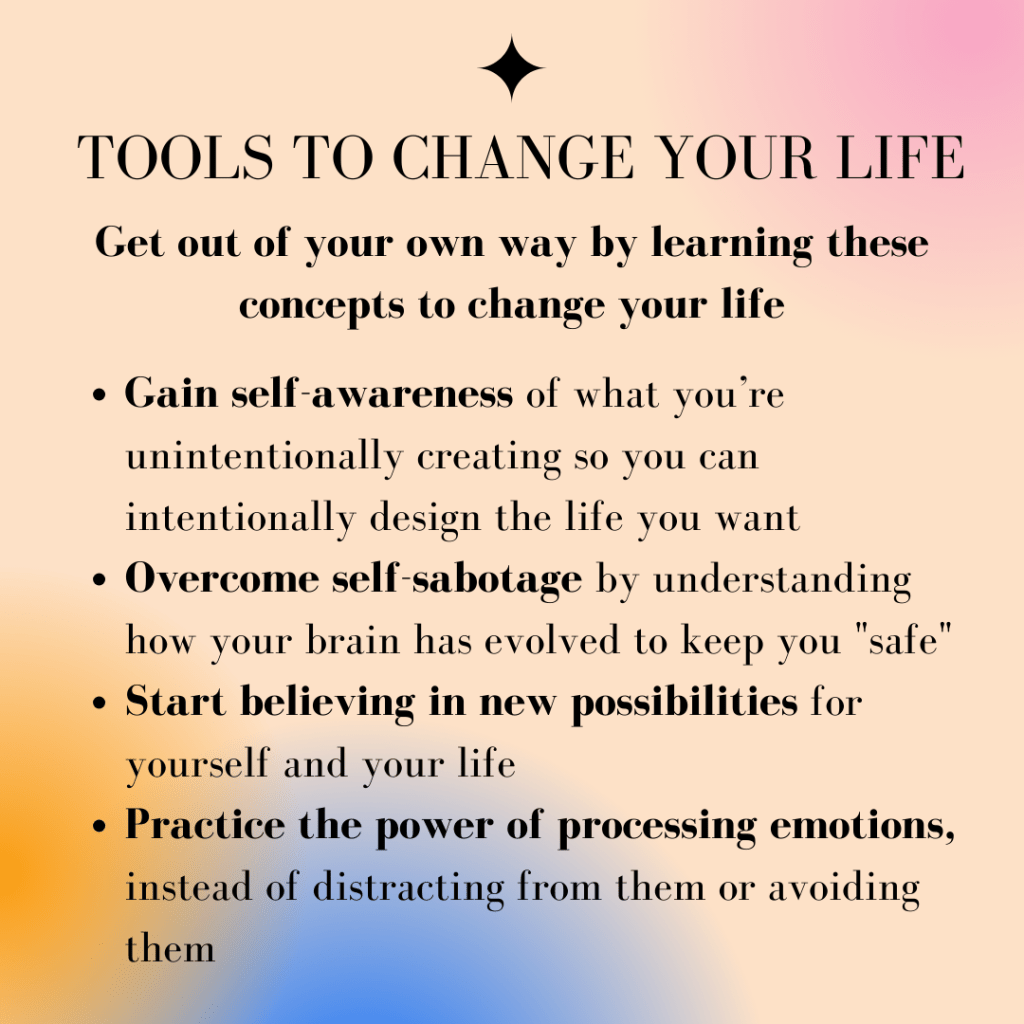
So I’ve created an introductory coaching series called “Tools to Change Your Life” to support others on their own path to stop giving their power away and take back control of their lives.

You can consider this program for yourself or for someone in your life who could benefit from a program like this!


Subscribe if you want to receive this content directly in your inbox.

Work with me: Want to see how self-care is transformative and can help you create the results you want in your life? I can show you how. Take six weeks. And, I offer first-time seekers a complimentary 60-minute exploratory session. Sign up here.

What’s on your mind? It can be powerful to learn from each other and our common struggles when it comes to our practice of self-care–or just being a human being. If you have something you’re struggling with and would like some perspective, share it here. Your issue may be chosen and addressed in the next post–it’ll be totally anonymous.

Sometimes our feelings hurt…a lot

And what if that’s OK?

All of us experience emotional pain at regular intervals in our lives. We often turn to food, alcohol, shopping, work, or something else to ignore the pain we feel. These actions are called buffering (more on that soon). These temporary distractions only prevent the process that needs to happen to let the painful feelings go.

What happens when feelings hurt:
• Something happens to trigger your emotional pain.
• You can barely make sense of it and it overwhelms you.
• Emotional pain racks your body—the vibrations in your body caused by the thoughts you’re having are excruciating.

You can make a choice to: avoid it, resist it, react to it, or process it.

Avoiding
When you choose to avoid your pain and pretend it isn’t there, you are basically lying to yourself. This doesn’t work long term. The truth is that avoidance causes pain to fester. The more you avoid it, the more you have to avoid it. You might eat, for example, instead of feel. Then you might get upset because you ate when you weren’t hungry. Then you might obsess about your body or your exercise routine. All of these tactics keep you from addressing the cause of the pain and instead, multiply undesirable symptoms such as weight gain.

Resisting and Reacting
When you resist the emotion, you tell yourself that you shouldn’t be feeling this way and then you feel bad in addition to the painful emotion you’re already feeling. When you resist, it’s like trying to hold a large beach ball under the water. The beach ball always wants to pop back up and gets stronger the more you try to push it down.

When you deal with pain this way, you act it out or fight against it. You might yell at the person you believe caused your pain. You might talk behind their back, you might give them the silent treatment, or maybe take even more drastic measures against them. This may seem to help with the pain temporarily because it alleviates the vibration in the moment, but these actions almost always backfire.

When we react from negative emotion, we almost always get a negative result. Our actions are usually uncontrolled and unthoughtful. Fighting against the emotion becomes a losing battle–anxiety speeds up the vibration of the already painful emotion, making it even more intense.

Processing
When you choose to process pain, you are choosing to feel it. We are so reluctant to feel pain on purpose. We tell ourselves that feeling pain is a bad thing because it feels bad, but this isn’t the truth. When we allow ourselves to feel our pain all the way through, we see that it’s manageable and it can do no long term harm (unlike avoiding and fighting, which can have many long term consequences).

Allow the feeling to be in your body even if you can’t make sense of it in your mind yet. Watch and notice. Say in your mind “I am processing pain” over and over as you feel the pain. You don’t need to fix it or make it go away.

Notice any desire to react, resist, and avoid. You can say the desire out loud or in your mind, or write it down. You don’t have to act on it—just acknowledge it. You can tell yourself, “That won’t help” or “That’s not worth it” every time you notice the desire. Remind yourself, “This is pain…This is part of being human.” Allow the painful vibration to be there as you do laundry, take a shower, drive your car, or talk on the phone. Notice its heaviness, its energy, its ability to take your breath away. Just notice.

As you do this, you’ll begin to see that your thoughts about the situation appear. It may take some time–a few minutes, a few hours, a few days, or a few weeks. Let it take as long as it takes—there’s no need to force it. Just keep noticing what you notice.

Your turn: What happens to the feeling if you just allow it to be there and feel it all the way through? What happens if you’re allowed to feel this way without reacting, resisting, or avoiding the emotion?

Next week we’ll talk about how our thoughts about our circumstances/situations create our feelings. It’s easy to think our circumstances (other people, our job, our neighborhood, traffic, etc.) create our feelings. It’s all our thoughts. And that’s where our power lies.

Subscribe if you’d like this content delivered right to your inbox!

You: Empowering and Disempowering Questions 

When we ask ourselves questions, our brains love to go to work to find the answers. When we ask ourselves disempowering questions, our brain will likely find disempowering answers. When we ask ourselves more empowering, curious, open questions, our brains will likely find options that feel more empowering or productive. 

What are three disempowering questions that you find yourself asking?

What are some more empowering questions you could ask yourself?

Below are some examples of disempowering (sound familiar?) and empowering questions:

Disempowering

Why do I keep doing this?

Why did I have to make that mistake?

Why isn’t he calling me back?

Why is this so hard?

Why can’t I get it right?

What’s wrong with me?

Why am I so messed up?

Empowering

How is this working for me?

What if this was all happening perfectly?

What if it’s okay that this is hard?

What would this look like if it was easy?

What am I learning from this?

How do I want to show up in this situation?

What’s right with me?

Who do I want to be?

Let me know if you’ve been asking yourself disempowering questions and are struggling to find more empowering questions to ask instead. We’ll work it out together! I offer first-time seekers a complimentary 45-minute exploratory session. Sign up here.

Disempowering questions and thoughts can contribute to unhealthy behaviors. And sometimes we’re not aware that they’re unhealthy until it’s too late. And that’s OK. That’s how we learn what isn’t working for us. And it’s a path forward to learning what DOES work for us, in healthier ways.

It’s OK to find out what isn’t working in order to move towards what does work – it’s probably the most common way we learn things. Sometimes we learn from our past experiences, a line in a book we’re reading, a story about someone else’s experience, or just being sick and tired of being sick and tired. 

I learned about some of my disempowering thoughts and beliefs through therapy and life coaching. And I’ve been doing the work to feel empowered and engage in my life in ways that DO work for me. It’s been so fulfilling to live differently by living INTENTIONALLY with awareness of what I’m creating in my life.

So I’ve created an introductory coaching series called “Tools to Change Your Life” to support others on their own path to becoming aware of what ISN’T working for them, so they can discover what DOES work for them.


Subscribe to get this content right in your inbox every week!

What’s on your mind? It can be powerful to learn from each other and our common struggles when it comes to our practice of self-care–or just being a human being. If you have something you’re struggling with and would like some perspective, share it here. Your issue may be chosen and addressed in the next post–it’ll be totally anonymous.

Transitions

Transitions

long shadows leap the length of my mind
twirling and spinning like orange brown leaves blowing in the lane

this year, this year 
I want it to be over, but
I don’t want it to end, to
mark another year passing where 
I didn’t “do” enough
what do I have to show for it?
nothing, is the easy answer
not enough, is the harder answer

this cycle, unstoppable 
Life, Death, Rebirth 
in every moment of the day, something dies
and something new comes forward 

can I allow this to be?
release the Resistance 
open to Acceptance 
settle into Surrender
feeling cradled by what is

this, being enough.

Nyeen Nyeen Has the Last Word

As a child I loved being dropped off at Nyeen Nyeen’s house on weekday mornings, with the sun shining brightly on the moss green carpets. The smell of toasting bread, butter, and syrup streamed out of the warm kitchen and Sesame Street called from the TV. “Sunny day, chasing the clouds away…” For a preschooler, these were all the comforts I needed.

The atmosphere that Nyeen Nyeen, my paternal grandmother, and Yeh Yeh, my paternal grandfather, created for my siblings and me was a respite from the rest of the world. There, we were carefree and catered to, with our sofa pillow forts, a backyard filled with insects to investigate and capture, and all the TV and snacks we wanted.  I can only remember one time when Nyeen Nyeen got so angry with me that she threatened to hit me with her wood-spined feather duster. I had drawn all over the hallway walls with a pencil and only escaped the feather duster by slipping under her bed and hiding where she couldn’t reach me.

But her life was more than childcare. Nyeen Nyeen endured a harsh childhood, and a tough immigrant’s life. She survived—indeed thrived—through strength, strong will, and determination. Everyone in my family inherited her survival skills because she provided such a steadfast example throughout our lives. Nyeen Nyeen became a binding force for our family.

She was born Bowe Kane Gee in 1919 in Toisan, China, in the villages of the Guangdong Province. She obtained a 6th grade education, which was common for girls at that time. However, she was fond of studying on her own, and throughout the years, she read Chinese classics and memorized Chinese poems, which she was still able to recite into her 90’s. She lived through the 1920’s, 30’s and 40’s, when war and famine spread across China. Because she experienced lack, uncertainty, and death, she hated to see anything wasted. We had to clean our plates at every meal—eat every grain of rice.

She married Kwok Poy Yee at the age of 16 in 1935, but was separated from him for over ten years during World War II while he was in the U.S. Navy. He was able to bring her to the United States in 1947 as a war bride, and they settled in San Francisco’s Chinatown. Nyeen Nyeen had to adjust quickly to both a new city and motherhood. She gave birth to daughters in consecutive years starting in 1947, 1948, then 1949, and to a son in 1952.

Lack of money and resources were issues for a new immigrant family that grew so quickly. During her Chinatown years, she mustered her strong will and determination to build survival strategies. She converted to Christianity out of gratitude to earlier arrivals who were slightly more established in Chinatown. These women saw Nyeen Nyeen’s struggle and reached out to help with what little they had. Converting to their new religion was her way of repaying their kindness. Her strong will and determination also sparked her entrepreneurial spirit. She worked as a seamstress and took English classes, and then she encouraged her husband to purchase businesses, which she ran: a laundromat, then a grocery store, and eventually a sewing factory, all within a 20-year period. Her husband, who worked at the Navy Shipyard since 1951, helped with the businesses at the end of his workday. They both put in long hours, and their kids helped out after school when they were old enough. Because of their collective efforts, they never struggled to put food on the table after the early years.

By the time I was born in 1980, Nyeen Nyeen had retired and Yeh Yeh would retire soon after. They cared for me and my siblings while my parents both worked full-time. At that time, Nyeen Nyeen’s hair was still almost all black with short curls. She had a robust figure with a solid bone structure, not fragile and small. I was always able to run to her and grab a strong hand, sit on a generous lap, or be folded into a bosomy embrace.

Nyeen Nyeen taught me how to write some Chinese characters, and I can understand a good amount of conversational Cantonese and Toisanese (our village dialect) from hearing her speak. And speak she did, quite often and loudly, telling stories, singing church songs, and talking about God. When she converted, she took on the role of “good Christian” like another job. She wanted everyone to convert and go to church, but her self-righteous tactics only pushed family members further away from organized religion. When I was small, she sang songs in her high falsetto about God, talking to me about how good He was, while I sat in her lap having my hair woven into a fishtail braid. She pulled hard, using a comb that felt sharp on my soft scalp, and applied baby oil to secure any stray strands.

As I got older, I saw her interactions with my family members could be quite judgmental and critical. She let others know exactly what she thought and felt, often to her own detriment because she pushed her own children to explode in anger, yelling back in order to defend themselves or prove her wrong. Why, they asked themselves silently, had they been given a mother who constantly tried their patience, complained, attacked their character, and questioned their decisions?

If Nyeen Nyeen was stressed out or overly worried about something, she imposed the burden onto others, calling my father or one of her other children, and immediately unloading her concerns without pause, for minutes at a time. She only hung up when she was done speaking and her burden felt reduced. The listener stayed on the line out of respect, while feeling bludgeoned and defeated, reluctant to experience it again, yet knowing a recurrence was inevitable.

Once, after Friday night dinner at her house, a shouting match began between Nyeen Nyeen and my father. Though not uncommon, this one reached a level of emotional violence that frightened me. I was nine years old, watching TV and trying to ignore the angry voices. My mother stayed out of it; she never got in the middle of their arguments. Finally my father stormed out of the kitchen and down the stairs. Then I heard Nyeen Nyeen crying. This was different from other times. I peered into the kitchen to see her at the table, her face in her hands as she sobbed. It was the first time I’d seen her vulnerability. Her hurt seeped into me. I went to her and put my arm around her shoulders to comfort her. She sobbed in Toisanese, “You’re the only one that cares about me. Everyone else just yells at me.” I felt like her protector and her only hope—it was a burden that I was willing to carry. I even felt a little indignant at my father, blaming him for unfairly causing her pain. Thinking back, I’m sure both of them were unfair to each other. Most likely Nyeen Nyeen even started it all, but none of that entered my head at the time.

Everyone who has known and loved Nyeen Nyeen has been greatly irritated, hurt, and frustrated at some point by her demands or criticisms. Yet they returned to her out of respect or obligation—some sense that they owed her a debt. They loved this woman who made it so difficult for them to do so. She battered people with her need to take care of others in the way she felt was correct, inundated them with her opinions, her values, her sense of what was right and wrong.

Her family had to stand their ground with her, stand up to her crushing, stubborn, accusing ways. Was nothing good enough for this woman? Interacting with her built personal strength, growth, determination, and in the long-term, patience. Somehow, forgiveness, or a willingness to look past a fight and try to understand her perspective, made way for reconciliation—or, simple resignation. It wasn’t worth it to argue with her. Later in our lives, my relatives began to realize that Nyeen Nyeen’s behavior arose from love and good intentions, and that learning to be patient with Nyeen Nyeen taught them patience with life.

As I got older, I too felt conflicting feelings about her. I always looked forward to seeing her and remembered her with adoration and respect. But when I was with her, her critical remarks immediately grated on me. “You’re not married yet. I want to see you married before I die. You know I don’t have many more years left on Earth.” Sometimes she said that I was too fat—while piling my plate with food. The next time, she’d say I was too skinny and piled my plate with food. My annoyance made me distance myself. Seeing this, my father reminded me that Nyeen Nyeen showed her love through food. Making sure we had enough to eat was a remnant of her past experience with famine. I wanted to snap back at Dad, “You should think of that the next time she shows her love for you and you get angry!” But of course, I didn’t.

As the matriarch of the family, Nyeen Nyeen could be bitter and biting but she could be generous, as well. She helped sponsor her relatives from China to the U.S. several times in her life and provided support while they adjusted to being here. And in her later years when she had enough abundance to do so, she shared her generosity by treating family and friends to meals at restaurants, always over-ordering food so that we could all take home leftovers.

Later in life, she dealt with major health crises, and the losses of her husband, her most supportive daughter, and many friends. I watched her repose at our family gatherings, dressed like many Chinese women of her generation in a polyester patterned blouse, a purple knit vest with gold buttons down the front, and navy blue crepe pants.  She sat silent in an armchair observing everyone around her chattering in English. I couldn’t tell if she felt lonely and left out or content and happy. Did she feel defeated by old age, or was she gratified to be surrounded by her little kingdom—family members happy, full, and present. These were the people she helped raise, the ones with her blood running through their veins, and their loved ones.

Whenever I had the chance to see Nyeen Nyeen in her last years, her face lit up with what seemed to be joy and pride. She greeted me with her signature laugh and a loud “Hi hon-ney!” I loved feeling like I was five years old again, running into her strong arms for a bosomy embrace.

At her funeral service in December 2013, a priest read her eulogy and praised her strong Christian values. Then he introduced a small surprise in the program, an older Chinese gentleman who was a congregation member from Nyeen Nyeen’s church. He read a list of our names, followed by Nyeen Nyeen’s last words to us, urging us to convert to Christianity so that our souls could be saved and we could reunite with her in Heaven. I gasped in surprise, feeling incredulous at Nyeen Nyeen’s last attempt to push her influence on us, even as she lay still and cold in her shiny, plush coffin. Then pride and recognition flooded me and I laughed out loud—Nyeen Nyeen had the last word after all! How right it was, how like her, to do something like this.

Nyeen Nyeen was part of my life for so long—she was my last living grandparent, living until she was 94 and I was 33. I miss her presence and hearing her voice speak in Toisanese. I miss the matriarch of our family, the one who imprinted herself on us, the one with the long memory of those she loved, the one who had the largest and most trying presence of us all, the one whose hurts and fears and weaknesses died with her, yet whose strength, determination, and will live on in us. And I feel her blood flowing through me when life metes out its harsh lessons and I have no choice but to move forward, as she would have done. Hers was a soul that I needed to know in my life, that I am lucky to have been nurtured by, in order to grow and proceed—to hone my survival skills—through this life in which she helped pave the way. I will never know another woman like her.
My Learnings – 2010s

I get emails from Marie Forleo because I signed up for her B-School program back in 2015. She is fun and passionate and teaches valuable stuff to entrepreneurs.

At the end of 2019, she had a series of videos about reflecting on the past decade: what you’re proud of and why, what you learned and why those lessons are important, and what you want your future self to know.

The exercises serve as a reflection on how far we’ve come and can guide us into the next decade with clarity.

I enjoyed reflecting and I felt empowered, encouraged, and enlivened because this exercise met my needs for appreciation, understanding, growth, and celebration. I’d like to share my “lessons learned” part of the exercise.

Everything happens FOR me
This idea resonated deeply with me when I first heard it, maybe around 2014 or so. It’s a reminder that even when “undesirable” things happen, it’s because I’m going to learn from that experience in some way, I’m going to grow from it, and expand my perspective through the process. Even the physical pain I’ve experienced on a monthly basis in the past, I believe happened FOR me so that I could really understand and embody what it means to take care of myself, to set boundaries, to accept what is, to relax into a challenging/uncomfortable situation and be with it, to have patience, to reflect and go within, to reach out and ask for help, and to value my body and its abilities even more when it’s not in pain. I have learned so much through the experience of the past monthly physical pain–even though it was so hard to be in it at times and I had to miss out on doing things I wanted to do. There are lessons even from that.

A definition of suffering = voluntary participation in events, situations, and circumstances that disempower you
Again, when I first heard this (from Iyanla Vanzant via Oprah’s Super Soul Conversations podcast, just this past August) it hit me hard as an empowering reminder that I can choose something else. I can choose not to participate, I do not have to stand there and be disempowered and suffer. Maybe it is more about emotional suffering than physical suffering, though emotions do create a physical response in the body. I went through a lot of emotional suffering in the past because I allowed myself to participate in disempowering situations, to give my power all away to someone else.

I am responsible for how I feel; I let everyone else off the hook
Another reminder (from Abraham via Esther Hicks) that I can choose, that I have a choice of feeling bad or feeling something else, that I have a choice to allow myself to stay in a bad feeling state or situation or choose to shift towards a better feeling state. This is a challenge sometimes and it’s a continual practice that I consciously engage in. It’s not easy but I believe it’s worth it in order to show up for myself and align my vibration with who I really am.

Listening to, honoring, and acknowledging my body; self-care in many forms
Without the freedom to move in my body, my world becomes much more limited, contracted, and it’s hard to keep a hopeful outlook on life. I know this feeling so well. Because of it, I have deeply embodied the learning and practice of checking in with my body to really listen to it and honor it and understand it. Creating some space for dialogue and language to support myself in this. And acceptance and self-empathy for when I’m not able to do what I want to do. This is a continual practice because I still find that I push myself too hard sometimes–my will wants to drag my body along behind it. But I ask it, “What can I do to help?” “How are you feeling?” “What do you need?” And I acknowledge it when I know I’ve pushed it a bit–or even when I haven’t. When I feel good, I acknowledge and thank it for the good feeling: “Yay, we did it! Thank you for supporting me in this.”

Be curious
This is so helpful in learning and to ask questions without the fear of being seen as “stupid” or thinking that we need to know everything or to be “right,” which the mind chatter has a way of scaring us into thinking. Curiosity is so important in the process of expanding yourself, to see what you’re capable of, to see what works and what doesn’t, to move forward with less fear. And it’s fun to be curious. 🙂

Have fun, be joyful
Life is supposed to be fun! Another teaching by Abraham. We are here for who knows how long or for what purpose, but doesn’t it feel good to enjoy yourself and have fun while we ARE here? The fact that we ARE here is a miracle and we get to be in our body which we can move, think, have freedom and independence, and to taste, touch, hear, see, smell is such a privilege. I am so grateful for all of my senses because they allow me to experience the world and my life fully.

Savor what feels good; celebrate
Again with the fun and joy. My teacher, David Ross formerly of the World School and currently at Andrew University, ingrains this into his students–and it’s a fun practice. Savor what feels good because it feels good to savor! And to be able to remember that good feeling in my body for a longer period of time, to be able to create and maintain that good feeling again whenever I want. Celebrate even the smallest victory. It’s a way to enjoy life even more.

I am taking these lessons into my next decade of life, continuously and consciously practicing them, and I’m sure I’ll learn even more along the way. Life is a continual process of growth and evolution, if we allow it to be. And I am allowing it! 🙂

Three Lessons from Emergency Open-Heart Surgery

Emergency open-heart surgery uprooted me from the life I was living in 2015. In the span of a month, I went from living in Manhattan to staying in a hospital in San Francisco for a month, and then permanently living back in San Francisco, which is my hometown. I would have liked making the move back home to have been of my own volition, but it wasn’t. And things work out the way they are meant to.

Through my recovery, I learned some things that help me live more fully.

~ I learned to listen to and honor my body
~ I learned to set and maintain boundaries around my energy and time
~ I learned to be kinder to myself

By learning and practicing these three lessons that help me embody my authentic self, I can continually give myself permission to learn and grow, to accept what already is and be grateful for it, while cultivating my desires for what’s next and practice being unattached to outcomes.

Living like this empowers me to align with my purpose, continually heal, and live in joy and connection with myself, others, and the Universe.