The Self-Coaching Model

Take responsibility.

The Life Coach School, where I received one of my coaching certifications from, teaches the Self-Coaching Model. It looks like this:

Circumstances are neutral and factual. They’re things that are mostly not under our control, like the weather and traffic. Circumstances also include what people say/don’t say and do/don’t do.

Thoughts are phrases that our minds produce about the Circumstances.

Feelings are one-word vibrations in our bodies, like scared, angry, happy, sad, nervous, excited, etc. that come from our Thoughts.

Actions are what we do or don’t do based on our Feelings.

Results are what we create for ourselves in our lives regarding the Circumstance when we take/don’t take Actions.

Our Results usually provide evidence for our Thoughts.

We’ve been conditioned to think that our Feelings come from the Circumstances. But there’s a space between the Circumstance and the Feeling, which is our Thought about the Circumstance. Circumstances are all neutral until we apply a Thought to them. When we apply a Thought to our Circumstance, we judge the Circumstance as “good” or “bad” and everything in between.

To read more about how this can play out in terms of how we feel, see below.


When we think other people cause our feelings, it looks like this:

Me: I’m going to a 75-minute yoga class today.

Mom: I really need your help with something today. Do you have to go to the yoga class?

Me: Feels guilty. (Thinks it’s because Mom said what she said. In reality, it’s because I’m thinking “I should stay home and help Mom” or “I’m selfish for going to yoga when Mom needs help”)

Mom isn’t “making” me feel guilty. I’m thinking a thought (or multiple thoughts) that are creating the feeling of guilt for myself. I’m responsible for my feeling of guilt. Mom is responsible for what she says. She is not responsible for me feeling guilty, even if that’s her intention. It’s whether I agree with her or not that I’ll feel guilty. And I may WANT to feel guilty.

From the feeling of guilt, one option of an action I take–likely an automatic response–is that I don’t go to the yoga class and help Mom. But that likely creates resentment, even if I agreed to do it. It wasn’t what I really wanted to do for myself.

When I recognize that I don’t have to think a thought that makes me feel guilty, another option–one that takes a bit more effort–is that I communicate with Mom and find a solution that works for both of us. For example, “I hear that you need help with something and I do want to help you. I also want to go to this yoga class. Would it work for you to do the task later today so that I can help you then?”

Or if the truth is that I know the task is something that I’ll have to take time to figure out and I don’t have time to do it, I can tell the truth to Mom, “Mom, I’m sorry, I don’t know how to do that and it’ll take too long to figure out. Would you be able to ask ____ / call a ____ to help you do it instead?”

These are just a few options and only one of them come from the feeling of guilt. There are multiple possibilities of responses that might work in this situation. We just have to recognize our automatic responses and take some time to communicate and find other creative solutions instead.

The Unintentional Model (automatic response) looks like:

C – Mom says “I need help with something. Do you have to go to the yoga class?”

T – I’m selfish for going to yoga when Mom needs help

F – Guilty

A – I don’t go to the yoga class, I stay home and help Mom, I don’t stick with my plan of going to yoga, I do something I’d rather not do

R – I don’t allow myself to take time for myself; OR I create resentment for myself

The Intentional Model looks like:

C – Mom says “I need help with something. Do you have to go to the yoga class?”

T – It’s possible for me to do both things

F – Empowered

A – let Mom know I want to help, ask if she can do the task later so I can help her then

R – I find a solution that works for both of us

If we’re willing to slow down a bit, we’re likely able to find solutions that work best for us while staying connected with others.
“It’s all gone terribly wrong”

But what if it hasn’t?

When we’re in the “other half” of our 50/50 emotional life, sometimes we may think something has gone terribly wrong, that maybe we’re wrong, that our life is wrong, that everything is wrong.

I want to offer that life and our human, emotional experience is 50/50 – 50% “good/positive” and 50% “bad/negative.”

It has to be this way because we wouldn’t know what “good” is without “bad.”

I think we’ve been taught incorrectly that our emotional lives should be “good” most, if not all, of the time. So when something happens and we feel the “bad” 50%, we think something has gone terribly wrong.

But if that “bad” 50% is supposed to be there, has anything really gone wrong?

No. We’re just in the 50% that sucks sometimes. And that’s okay. We’re okay. It’s all okay. We’re in the human experience.

It may not feel okay in the moment, but when we can stay with the negative feeling and allow and process our emotions, that’s when we’ll move forward. 

Avoiding the negative emotion can hurt us. Instead of experiencing the emotion, we buffer: we seek other things to make us feel better. Other things, like false pleasures, we don’t necessarily want, like over-eating, over-drinking, binging Netflix, over-Instagraming, over-working, over-spending, etc. 

We do these actions instead of allowing and processing an uncomfortable emotion like boredom, loneliness, shame, fear, jealousy.

But experiencing the negative emotion can help us. When we’re willing to experience the range of emotions, we open our lives up so much more. That’s when we know we can handle any emotion.

When we open up to the 50/50, we get some authority over it. Then we don’t have to be in a hurry to seek false pleasure or change things impulsively to feel better. 

Your turn: How would your life be different if you recognize that your emotional life is 50/50 and that’s okay? Are you open to allowing and processing negative emotions instead of avoiding or resisting them? What would you be more willing to do for yourself if you embraced the 50/50 of your emotional life?

Subscribe if you want to receive this content directly in your inbox.

Work with me: Want to see how self-care is transformative and can help create a more meaningful life in which you start committing to yourself and show up the way you want? I can show you how. I offer first-time seekers a complimentary 45-minute exploratory session. Sign up here.

What’s on your mind? It can be powerful to learn from each other and our common struggles when it comes to our practice of self-care–or just being a human being. If you have something you’re struggling with and would like some perspective, share it here. Your issue may be chosen and addressed in the next post–it’ll be totally anonymous.

You’re already 100% worthy

Believe it.

I used to run around trying to do all these things in order to prove that I was worthy. I used to overwork myself at my job. I used to volunteer on weeknights and on the weekends. I used to say “yes” to everyone and everything. 

I thought I had to DO all these things in order to show that I had value.

Now, I still do a lot of things, but it’s no longer coming from a place of “I need to prove myself and my worthiness.” Now what I do comes from a place of wanting to contribute because I know I have value to add. 

Through my coaching school, The Life Coach School, I learned to believe that I am already 100% worthy. I always have been. I just didn’t know that this was something I could believe about myself. 

Most of us aren’t taught to believe that we’re already worthy. What we are taught is to believe that we have to perform, achieve, and accomplish in order to feel worthy and valuable. That we have to please everyone and get everyone to like us to feel worthy and valuable. 

We were not taught that our own self-approval, self-acceptance, and our thoughts about ourselves are more important than what other people think about us or even what we think other people think about us. 

Much of the time, we do things because of what we think other people will think about us. We’ve been conditioned to do this. But we can’t control what other people think. Not if we do “good” things or if we do “bad” things. They will think whatever they want about us and that’s based on them and not us.

We build our self-worth through our thoughts about ourselves. Not through what we do for our work or job, what we do or don’t do for others, or what we do well or don’t do well.  

We build our self-esteem through our relationship with ourselves, which is what we think about ourselves. What kind of thoughts do we have about ourselves? What do we think when we look in the mirror? What do we think when we make a mistake? What do we think when something goes the way we wanted it to go? These are all thoughts we have about ourselves. 

Once we become aware of our current thoughts about ourselves, we can see whether they’re in alignment with how we want to feel about ourselves. If we wouldn’t let others talk to us in a certain way, why do we let ourselves do that?

Your turn: “I’m already 100% worthy.” Do you believe that? What about, “It’s possible that I’m already 100% worthy,” or “It’s possible that I can learn to believe that I’m already 100% worthy.” What would happen if you practiced one of these thoughts every day?

What kind of thoughts do you think about yourself? Is there anything you’d like to change about that? If so, what?

Subscribe if you want to receive this content directly in your inbox.

Work with me: Want to see how self-care is transformative and can help create a more meaningful life in which you start committing to yourself and show up the way you want? I can show you how. I offer first-time seekers a complimentary 45-minute exploratory session. Sign up here.

Why you’re behaving that way

Our feelings fuel us.

Everything we do in our life is because we want to feel a certain way. Everything we want in our life is because of a feeling–the feeling that we think we’ll have in getting it or the feeling we think we’ll avoid in not getting it. This is really good to know. 

And if we know that our feelings are caused by our thoughts and that what we do in our life is in order to feel better, wouldn’t it be important to know what you’re thinking? 

We’ve already talked about circumstances, which are the facts that happen in our lives and which we usually don’t have control over. We’ve also talked about how we think about those circumstances creates our feelings. It’s not the circumstances that create our feelings.

Our feelings are also important because they drive all of our actions. Feelings are the fuel for our actions. So when someone asks me, “Why am I not taking action?” It’s because of the way they feel. Or if they’re taking an action they don’t want to be taking, it’s because of the way they feel. So our feelings are driving our actions. And then our actions are always going to create the results we get–sometimes they’re results we want or results we don’t want in our life. Our actions create our results.

But our actions stem from our feelings and our feelings come from our thoughts. So if we want different results, ultimately, we need to think different thoughts.

So sometimes the reason why we don’t take a certain action is to avoid a feeling we think will happen after taking that action. This can look like declining a big opportunity because we’re feeling doubt and thinking something along the lines of, “I might fail and I don’t want to feel the dejection of failure.” 

Other times, we feel a certain way and because we feel that way, we either take or don’t take action. This can look like feeling nervous because we’re thinking, “I don’t want to look stupid in front of everyone,” so we don’t offer our opinion in a meeting. Or we feel hurt because we’re thinking, “He should want to spend more time with me,” which causes us to disconnect from our partner, which is an action that doesn’t serve us or our relationships–it’s actually the opposite of what we want here.

When we have results in our lives that we don’t want, it’s good to be aware that it’s our actions that are creating them. And where do our actions come from? The way we’re feeling. And where does the way we’re feeling come from? The way we’re thinking about our circumstances. 

To create different results, we need to think different thoughts.

Your turn: What feelings are fueling your actions? What actions are you taking when you experience those feelings? And what results are your actions creating for you? Do you like the results you’re getting?

Subscribe to receive this content in your inbox.

Work with me: Want to see how self-care is transformative and can help create a more meaningful life in which you start committing to yourself and show up the way you want? I can show you how. I offer first-time seekers a complimentary 45-minute exploratory session. Sign up here.

Are you struggling to make healthy changes?

Sometimes your brain gets in the way.

Why is it so hard sometimes to make changes in our lives that have long-term benefits?

Because of how our brains have evolved. The prefrontal cortex is the part of our brain that makes us human. It can plan and think about what it’s thinking about. Our primal, lower brain is the same brain that animals have. It wants to be efficient, avoid pain, and seek pleasure–the Motivational Triad.

Change is new and different. We’re not used to doing new things. So the primal brain doesn’t get to be efficient when we’re implementing changes. It wants to go back to doing what it knows how to do and what it’s already good at doing. The easy stuff that we’ve been doing, which isn’t getting us the results we want in our lives.

When we’re making changes in our lives, we’re usually also experiencing discomfort. Whether it’s because we’re waking up earlier, eating less sugar, drinking less alcohol, feeling deprived, moving our bodies more, or spending less money. We’ve been used to the instant gratification, which is what the brain likes–the seeking of pleasure and the avoidance of pain. Doing these new things doesn’t give us instant gratification. But it will give us long-term benefits.

How do we push past the discomfort? It’s not by using willpower. It goes back to processing and allowing feelings. And to using our prefrontal cortex.

We use our prefrontal cortex to make plans to implement long-term change. But our primal brain likes to try to override these plans because it wants to be efficient, avoid pain, and seek pleasure. So we make a plan first—and know that the primal brain will try to impose.

If we want to stop overeating, we decide 24 hours ahead of time what we’re going to eat and eat only that.

If we want to stop overdrinking, we decide 24 hours ahead of time how many drinks we’re going to have and have only that.

If we want to stop overspending, we decide 24 hours ahead of time how much we’ll spend and spend only that.

The primal brain will create urges. So when we have an urge to overeat, we have to allow that urge to be there and feel it. Usually the urge will pass if we’re not fighting against it.

When we have an urge to buy something new, we allow it the urge to be there and feel it. And let it pass and stick to our spending plan.

When we have an urge to do anything that deviates from our plan, we allow that urge and let it pass without fighting it or thinking we need to answer that urge.

It might seem impossible. But once you start practicing allowing urges, it can become easier.

Your turn: Think about the last time you did something that seemed impossible for you to do. But then you decided to do it and you did it. When you actually did it, what did you think of it afterwards? The fact that you did it probably felt gratifying and instilled the confidence that you could do it again if you wanted to. What would happen if you made a plan 24 hours in advance and allowed an urge to be there without answering it? How would doing that bring you closer to the results you want in your life?

Subscribe if you’re enjoying this content and want it delivered to your inbox!

Stop giving your power away

You’re in charge of how you feel.

Last week we talked about how to process and allow painful emotions. It’s easy to think that external circumstances like other people, things, outcomes, and events, cause us to feel a certain way. What really causes us to feel a certain way is how we think about those external circumstances. 

Do you know why circumstances don’t cause our feelings? Because two different people could experience the exact same circumstance, but depending on how each of them thinks about the circumstance, their thoughts will create their feelings. So it’s not the circumstance. It’s the thoughts.

For example, one person gets cut off while driving. She could immediately get angry and vengeful and try to cut that other person off because she’s thinking, “This person is a jerk! How dare he do that to me. I’ll show him!” And sometimes this anger can start a spiral of negative thoughts and emotions for the rest of the day.

Another person who gets cut off while driving could feel some annoyance but then get over it easily because he’s thinking, “Yikes! I know how it feels to be in a rush like that and I’ve done that type of thing before without meaning to.” Some initial annoyance, but pretty quickly letting it go and not letting it ruin his day.

Same circumstance, but different thoughts, which create different feelings–and ultimately, different results. 

When we let other people have so much control over our feelings, we’re giving our power away to them. We’re saying, “How you’re behaving/what you’re saying/what’s happening ‘out there’ is determining how I feel, so I have no control over my feelings.”

But we do have control. That control is in our thoughts. Our thoughts are where our power lies.

Most of the time, we make other people’s words and actions mean something about us and we think we have to protect ourselves from something, protect our egos. 

For example, when a colleague offers another way of doing something than what we suggested, we might get defensive because we might think, “He doesn’t respect my opinion.” Then we may feel angry and defensive because we made it mean something about ourselves–usually something related to “I’m not good enough.” Then we proceed to act in a certain way that deteriorates our relationship with that colleague. 

What if instead we thought, “He could be offering a more efficient way to do it. Let’s see if it can work”? That thought will create a totally different feeling. We didn’t make our colleague’s words/actions mean anything about ourselves. We didn’t take it personally or need to defend ourselves. This other thought might create the feeling of “curiosity” or “openness,” which leads us to collaborate with that colleague in a cooperative way. 

Two different outcomes because of two different thoughts–but the circumstances were the same.  Starting to see a pattern? 😉

When we take responsibility for our feelings, we stop giving our power away to other people and situations. We are in charge of how we think and feel. 

When we take responsibility for our feelings, we are in emotional adulthood instead of emotional childhood.

More about emotional adulthood and childhood next week!

Your turn: What are you making someone’s words or actions mean about yourself? What if their words or actions don’t have to mean anything about you? Are you open to becoming more aware of the thoughts you’re thinking and how they’re creating your feelings? What are the three most frequent emotions you feel during a typical day? What are the thoughts creating those emotions? 

I learned how to stop giving my power away through therapy and life coaching. And I’ve been doing the work to feel empowered and engage in my life in ways that DO work for me. It’s been so fulfilling to live differently by living INTENTIONALLY with awareness of what I’m creating in my life.

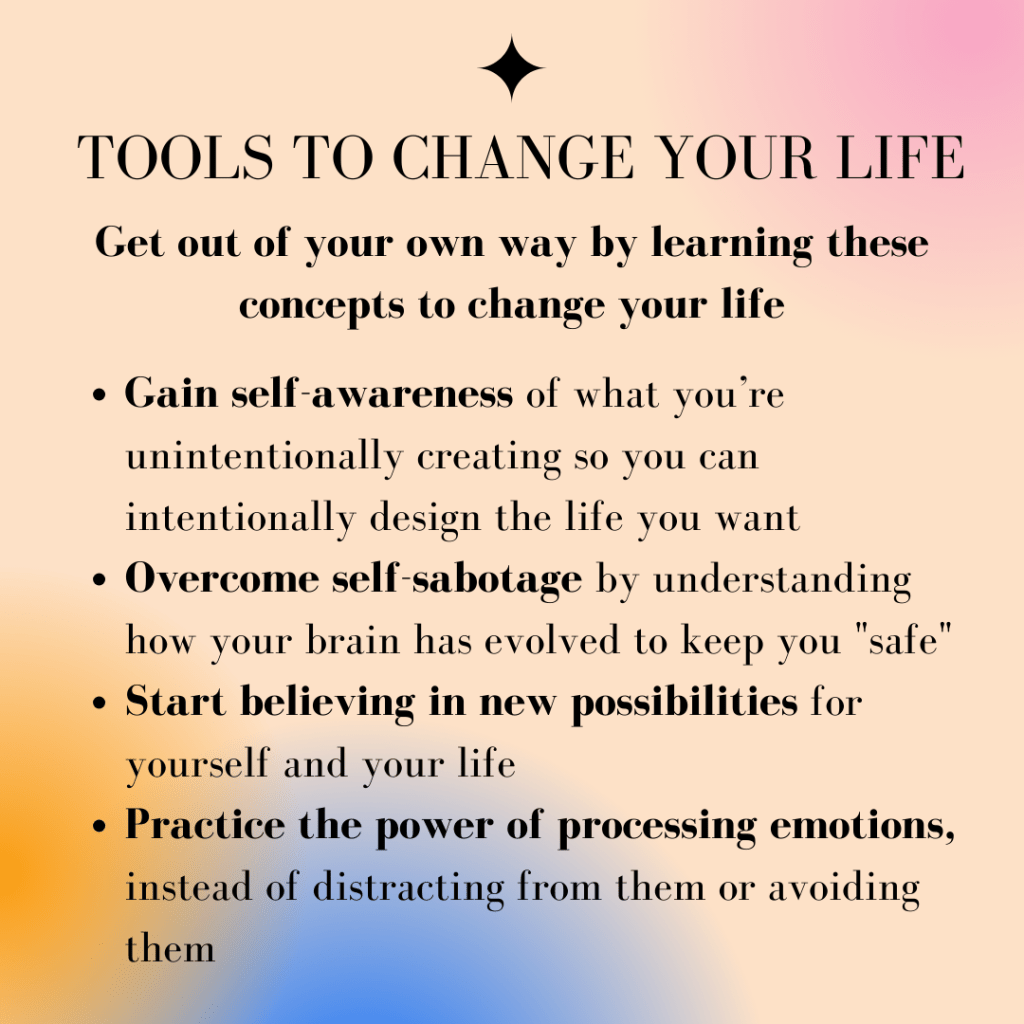
So I’ve created an introductory coaching series called “Tools to Change Your Life” to support others on their own path to stop giving their power away and take back control of their lives.

You can consider this program for yourself or for someone in your life who could benefit from a program like this!


Subscribe if you want to receive this content directly in your inbox.

Work with me: Want to see how self-care is transformative and can help you create the results you want in your life? I can show you how. Take six weeks. And, I offer first-time seekers a complimentary 60-minute exploratory session. Sign up here.

What’s on your mind? It can be powerful to learn from each other and our common struggles when it comes to our practice of self-care–or just being a human being. If you have something you’re struggling with and would like some perspective, share it here. Your issue may be chosen and addressed in the next post–it’ll be totally anonymous.

Sometimes our feelings hurt…a lot

And what if that’s OK?

All of us experience emotional pain at regular intervals in our lives. We often turn to food, alcohol, shopping, work, or something else to ignore the pain we feel. These actions are called buffering (more on that soon). These temporary distractions only prevent the process that needs to happen to let the painful feelings go.

What happens when feelings hurt:
• Something happens to trigger your emotional pain.
• You can barely make sense of it and it overwhelms you.
• Emotional pain racks your body—the vibrations in your body caused by the thoughts you’re having are excruciating.

You can make a choice to: avoid it, resist it, react to it, or process it.

Avoiding
When you choose to avoid your pain and pretend it isn’t there, you are basically lying to yourself. This doesn’t work long term. The truth is that avoidance causes pain to fester. The more you avoid it, the more you have to avoid it. You might eat, for example, instead of feel. Then you might get upset because you ate when you weren’t hungry. Then you might obsess about your body or your exercise routine. All of these tactics keep you from addressing the cause of the pain and instead, multiply undesirable symptoms such as weight gain.

Resisting and Reacting
When you resist the emotion, you tell yourself that you shouldn’t be feeling this way and then you feel bad in addition to the painful emotion you’re already feeling. When you resist, it’s like trying to hold a large beach ball under the water. The beach ball always wants to pop back up and gets stronger the more you try to push it down.

When you deal with pain this way, you act it out or fight against it. You might yell at the person you believe caused your pain. You might talk behind their back, you might give them the silent treatment, or maybe take even more drastic measures against them. This may seem to help with the pain temporarily because it alleviates the vibration in the moment, but these actions almost always backfire.

When we react from negative emotion, we almost always get a negative result. Our actions are usually uncontrolled and unthoughtful. Fighting against the emotion becomes a losing battle–anxiety speeds up the vibration of the already painful emotion, making it even more intense.

Processing
When you choose to process pain, you are choosing to feel it. We are so reluctant to feel pain on purpose. We tell ourselves that feeling pain is a bad thing because it feels bad, but this isn’t the truth. When we allow ourselves to feel our pain all the way through, we see that it’s manageable and it can do no long term harm (unlike avoiding and fighting, which can have many long term consequences).

Allow the feeling to be in your body even if you can’t make sense of it in your mind yet. Watch and notice. Say in your mind “I am processing pain” over and over as you feel the pain. You don’t need to fix it or make it go away.

Notice any desire to react, resist, and avoid. You can say the desire out loud or in your mind, or write it down. You don’t have to act on it—just acknowledge it. You can tell yourself, “That won’t help” or “That’s not worth it” every time you notice the desire. Remind yourself, “This is pain…This is part of being human.” Allow the painful vibration to be there as you do laundry, take a shower, drive your car, or talk on the phone. Notice its heaviness, its energy, its ability to take your breath away. Just notice.

As you do this, you’ll begin to see that your thoughts about the situation appear. It may take some time–a few minutes, a few hours, a few days, or a few weeks. Let it take as long as it takes—there’s no need to force it. Just keep noticing what you notice.

Your turn: What happens to the feeling if you just allow it to be there and feel it all the way through? What happens if you’re allowed to feel this way without reacting, resisting, or avoiding the emotion?

Next week we’ll talk about how our thoughts about our circumstances/situations create our feelings. It’s easy to think our circumstances (other people, our job, our neighborhood, traffic, etc.) create our feelings. It’s all our thoughts. And that’s where our power lies.

Subscribe if you’d like this content delivered right to your inbox!

You: Empowering and Disempowering Questions 

When we ask ourselves questions, our brains love to go to work to find the answers. When we ask ourselves disempowering questions, our brain will likely find disempowering answers. When we ask ourselves more empowering, curious, open questions, our brains will likely find options that feel more empowering or productive. 

What are three disempowering questions that you find yourself asking?

What are some more empowering questions you could ask yourself?

Below are some examples of disempowering (sound familiar?) and empowering questions:

Disempowering

Why do I keep doing this?

Why did I have to make that mistake?

Why isn’t he calling me back?

Why is this so hard?

Why can’t I get it right?

What’s wrong with me?

Why am I so messed up?

Empowering

How is this working for me?

What if this was all happening perfectly?

What if it’s okay that this is hard?

What would this look like if it was easy?

What am I learning from this?

How do I want to show up in this situation?

What’s right with me?

Who do I want to be?

Let me know if you’ve been asking yourself disempowering questions and are struggling to find more empowering questions to ask instead. We’ll work it out together! I offer first-time seekers a complimentary 45-minute exploratory session. Sign up here.

Disempowering questions and thoughts can contribute to unhealthy behaviors. And sometimes we’re not aware that they’re unhealthy until it’s too late. And that’s OK. That’s how we learn what isn’t working for us. And it’s a path forward to learning what DOES work for us, in healthier ways.

It’s OK to find out what isn’t working in order to move towards what does work – it’s probably the most common way we learn things. Sometimes we learn from our past experiences, a line in a book we’re reading, a story about someone else’s experience, or just being sick and tired of being sick and tired. 

I learned about some of my disempowering thoughts and beliefs through therapy and life coaching. And I’ve been doing the work to feel empowered and engage in my life in ways that DO work for me. It’s been so fulfilling to live differently by living INTENTIONALLY with awareness of what I’m creating in my life.

So I’ve created an introductory coaching series called “Tools to Change Your Life” to support others on their own path to becoming aware of what ISN’T working for them, so they can discover what DOES work for them.


Subscribe to get this content right in your inbox every week!

What’s on your mind? It can be powerful to learn from each other and our common struggles when it comes to our practice of self-care–or just being a human being. If you have something you’re struggling with and would like some perspective, share it here. Your issue may be chosen and addressed in the next post–it’ll be totally anonymous.