Need to be needed

By you.

How many of us have felt the “need to be needed” by other people? We might feel this need because we think it gives us meaning. We might think it gives us purpose. We might think it gives us value.

I think it can do all of those things. And we can also let needing to be needed get the best of us. 

When that happens, it looks like needing to feel indispensable so you don’t lose your job. Or needing to be needed in a relationship so the other person doesn’t leave you. Or needing to be needed so you feel like you matter. 

When we feel the “need to be needed” in these ways, it’s part of our evolutionary survival selves. We want to belong and not get outcast by the tribe. So we seek to control outcomes in order to feel safe or secure. We become the person who takes care of everything, who has all the answers, who knows where everything is, who takes care of everyone else. 

Or we become the person who makes the plans all the time, who always stays late after work to help someone who had to leave early, who puts out fires, who does all the things. In our efforts to feel needed, we put others before ourselves and our needs. And sometimes we feel resentful and unappreciated.

In small and intentional doses, being needed can be a normal part of being on a team or in partnership. However, if it becomes a pattern – or is even automatic and maybe not questioned – not only does this become exhausting, but we lose sight of taking care of ourselves because we’re too busy worrying about and taking care of others. And sometimes, this comes from an unconscious need to seek our value and worth outside of ourselves.

This is not to say that we stop being considerate or thoughtful of others, or withdraw our care or team effort from them, but rather, we can start thinking about what WE truly need and want. 

Just so we know it for ourselves. 

Because others might not always need us. Kids grow up, relationships end, friendships change, people get laid off. People change their minds. But you know who will always need you? YOU. 

Need to be needed by YOU. You need YOU to be there for you. You need YOU to support you. You need YOU to believe in you. You need YOU to take care of you. YOU will always be there for you, no matter what.

When we start intentionally being there for ourselves, we might find that we can be there for others with less resentment, less anger, less overwhelm and more presence, connection, compassion, and curiosity. 

Your turn: Do you have a need to be needed? What does needing to be needed by YOU feel like? In what ways do you need to be needed by you?

Subscribe if you want to receive this content directly in your inbox.

Work with me: Want to see how self-care is transformative and can help you create the results you want in your life? I can show you how. I offer first-time seekers a complimentary 60-minute exploratory session. Sign up here.

What’s on your mind? It can be powerful to learn from each other and our common struggles when it comes to our practice of self-care–or just being a human being. If you have something you’re struggling with and would like some perspective, share it here. Your issue may be chosen and addressed in the next post–it’ll be totally anonymous.
What? I don’t have needs

Yes, you do. And that’s OK.

When I first learned that having needs is a part of the human experience and that it was “OK” to have needs, I felt embarrassed for myself. I thought, “What? I shouldn’t have needs.” 

I was conditioned to think that having needs was a weakness, that being “needy” was undesirable. So I was resistant to the idea of actually having needs. 

But as I learned more about feelings and needs via the Non-Violent Communication (“NVC”) philosophy by Marshall Rosenberg, I began to understand myself better. 

I learned how needs are an important part of our lives and for living fully and authentically. I started to accept that I DO have needs. I became more familiar with my needs and what they communicate to me and my lived experience. I became more connected to myself. 

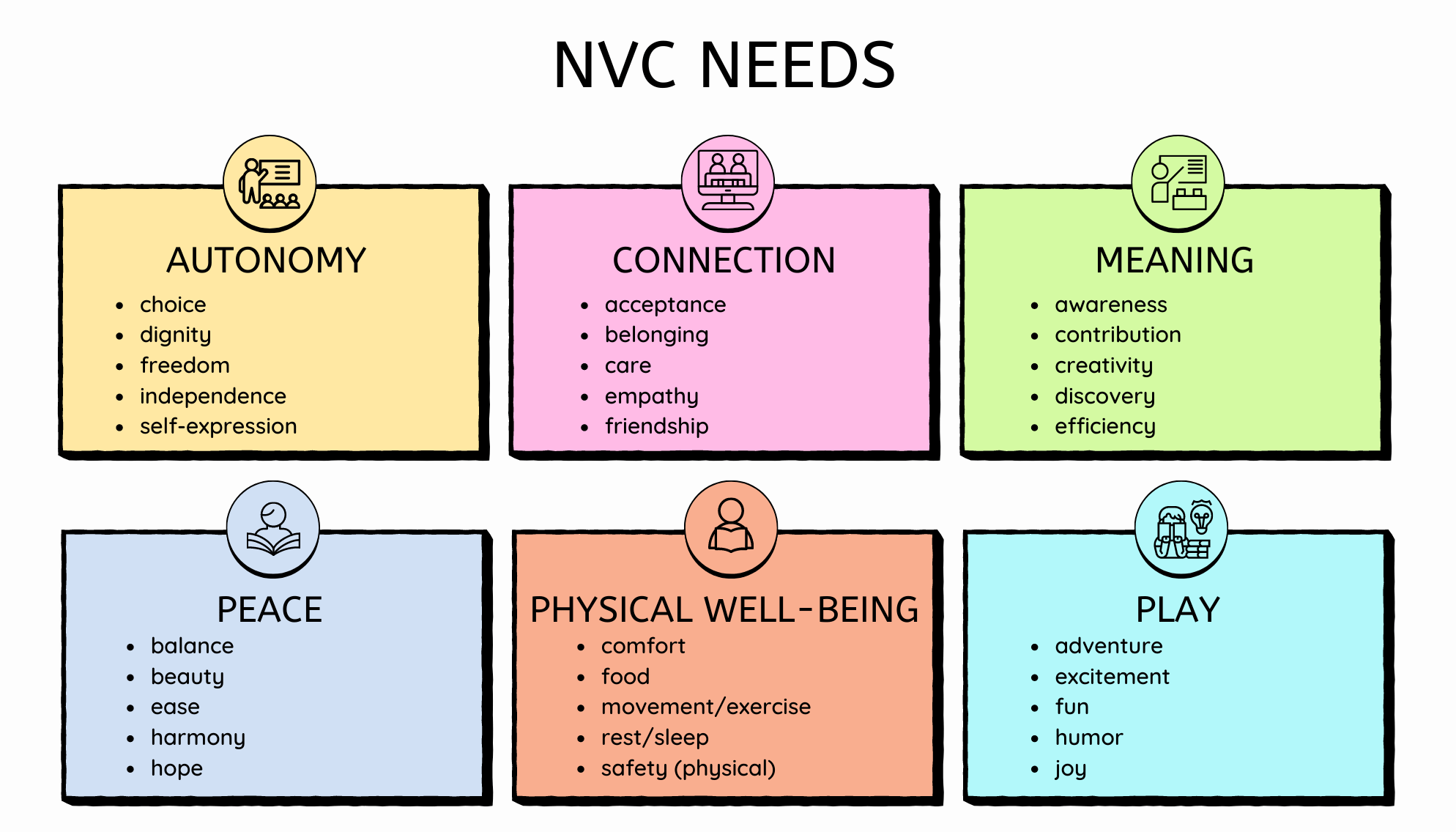
In NVC, having needs is universal to all humans. It’s different than the dictionary definition for “need.” For example, here are a few universal human needs (here is a fuller list):

We know from the Model that our thoughts create our feelings. In NVC, we recognize that our feelings are also based on whether or not our needs are being met. When we have “met” or “unmet” needs, we’ll have a thought about what’s going on when our needs are met or unmet and then feel a feeling associated with that thought. 

NVC teaches us how to acknowledge our needs and make requests from other people to help meet our needs. However, we are ultimately responsible for meeting our own needs by connecting with and taking care of ourselves. 

Your turn: What needs of yours do you want to acknowledge and even embrace? How might doing this provide more connection to yourself and your lived experience? What do you want to learn more about needs and how to express them in healthy ways?

Subscribe if you want to receive this content directly in your inbox.

Work with me: Want to see how self-care is transformative and can help create a more meaningful life in which you start committing to yourself and show up the way you want? I can show you how. I offer first-time seekers a complimentary 60-minute exploratory session. Sign up here.

What’s on your mind? It can be powerful to learn from each other and our common struggles when it comes to our practice of self-care–or just being a human being. If you have something you’re struggling with and would like some perspective, share it here. Your issue may be chosen and addressed in the next post–it’ll be totally anonymous.

When you ignore yourself

Acknowledge your needs.

So many of us are used to placing other people’s needs and desires before our own. We’ve been conditioned that way through our family culture and our cultural norms. 

To allow ourselves to consider different ways of being, we first need to become aware of what we are doing automatically, without thinking about it. When we become aware of our automatic responses, we can then slow down and choose on purpose. 

And first, we have to know what the other options and choices are for us. We can start by asking some questions:

  • What is my automatic response to this type of situation?
  • Why do I respond this way?
  • What do I think will happen if I don’t respond the way I always do?
  • Am I willing to feel uncomfortable and do something different?  

Then we can decide what we want to explore doing instead. Some options could be:

  • “I want to think about it and get back to you tomorrow by noon.”
  • “I had plans for that time already, but I know this is important to you. Let’s see what can work for both of us.”
  • “This is urgent and I’m willing to focus my time on this instead of what I had planned.”
  • “This isn’t urgent, even though I used to make it urgent, and I want to focus on what I had planned instead.”

One thing that really made a difference for me, even though it may seem small: I used to put off going to the bathroom at work until it became urgent. Our bodies let us know when it’s urgent! But I wasn’t being very nice to my body or myself when I waited until I urgently needed to pee. It’s like I was my body’s warden and not allowing it to pee until it became an emergency. Now, when I need to pee, I go to the bathroom as soon as I feel it; or I plan ahead of time to pee before a meeting so it doesn’t become urgent. This lets my body know it can trust me to take care of its needs.

It may seem small, but it started to change things for me. I started to become aware of my own needs and asked myself, “Where else in my life am I ignoring myself by not taking care of my needs until they become urgent?”

Your turn: How do you want to respond on purpose? What might you need to change in order to recognize and acknowledge your needs more? Where in your life are you ignoring yourself by not taking care of your needs until they become urgent?

Subscribe if you want to receive this content directly in your inbox.

Work with me: Want to see how self-care is transformative and can help create a more meaningful life in which you start committing to yourself and show up the way you want? I can show you how. I offer first-time seekers a complimentary 45-minute exploratory session. Sign up here.

What’s on your mind? It can be powerful to learn from each other and our common struggles when it comes to our practice of self-care–or just being a human being. If you have something you’re struggling with and would like some perspective, share it here. Your issue may be chosen and addressed in the next post–it’ll be totally anonymous.