How to enjoy being you

It’s a practice.

What does enjoying “being you” look like?

When we don’t like ourselves, it’s hard to enjoy being ourselves. But sometimes we don’t even realize we don’t like ourselves—until we notice how often we’re getting frustrated and upset with ourselves.

This might look like quickly overcommitting to things. Staying up late rethinking what we said.  Trying to be the perfect version of ourselves wherever we are.

This isn’t a flaw. It’s a signal. These are clues pointing us back to the part of us that’s still trying to earn belonging.

A client once shared this with me:

She had just finished a long workday when a friend texted asking for help on something she’d procrastinated on. My client’s instinct was to say No. She was exhausted.

But what came out was, “Of course! No problem.”
Then she stayed up past midnight trying to finish both her friend’s request and her own to-do list.

The next day she felt tired and irritated—and really, disappointed in herself.

We explored it together and underneath the resentment wasn’t just over-giving. It was the belief: If I say no, she might not like me.
And beneath that: I don’t feel like I’m enough as I am.

When we don’t like ourselves, it shows up in these quiet ways. But that doesn’t mean there’s something wrong with us. It just means we’ve learned to measure our worth by how others respond to us.

That’s why liking yourself is a practice. It’s not a personality trait, something you either have or don’t have.

It’s something you build—the same way you would a relationship. Because it’s your relationship with yourself.
We practice with presence, with care, with forgiveness. And maybe even a little humor.

We don’t have to wait until we’ve “fixed” ourselves to start liking ourselves.
We just have to be willing to have our own back. No matter what.

And like any practice, we get better by doing it.

Your Turn:

  • What’s one way you notice yourself hustling for approval?
  • What’s something you appreciate about who you are right now—without changing a thing?
  • How can you practice having your own back this week?

The most powerful kind of approval

Your own.

I used to run around trying to prove I was worthy.

I overworked myself at my job. I volunteered on weeknights and weekends. I said “yes” to everyone and everything.

I thought if I did enough, I’d finally feel valuable. But because I didn’t know how to approve of myself, I kept seeking that approval from others—and at my own expense.

What I didn’t know back then: You can seek your own approval. 

In fact, your own approval is the most important of all. Because only you get to decide whether you approve of yourself.

Even when we try to seek approval from others, we can’t control what people think of us. People will form opinions based on them—their experiences, conditioning, values, beliefs—not necessarily based on us.

Imagine being in a room with 10 people. You say or do something meaningful to you. Chances are, you’ll get 10 different interpretations. You didn’t change what you did—but each person filters it through their own lens.

If we’re chasing approval from all 10 people, we might get praise from a few… and judgment from a few others. It’s a losing game, and it pulls us away from who we really are.

Instead, we can learn to ask:
“How do I want to show up?”
“What feels aligned for me?”

When we act from our values—when we behave in ways we’re proud of—we can approve of ourselves, regardless of what anyone else thinks.

Now, I still do a lot of things. But I’m no longer doing them to prove my worth.

I do them because I want to.  Because I know I have value to contribute. Because I know I’m already worthy.

But most of us weren’t taught that we’re already worthy. I know I wasn’t.

What we’re often taught is that worth has to be earned—through performance, achievement, likability. That if we want to belong, we have to please. That if we want to be accepted, we have to keep the peace.

But real belonging never asks you to betray yourself.

When we build self-approval, we become more able to connect authentically—with people who see us clearly, and who love us as we are. We stop bending and breaking ourselves to be palatable. We start showing up as more of ourselves. And from that place, real belonging becomes possible.

Your turn:

Do you believe that you are already 100% worthy?

If not, could you try on the thought: “It’s possible that I’m already 100% worthy”?

What might change if you practiced believing that?

Where in your life are you tempted to hide or perform to feel like you belong?

What would it look like to bring more of your true self into those spaces?

Subscribe if you want to receive this content directly in your inbox.

Work with me: Want to see how self-care is transformative and can help you create the results you want in your life? I can show you how. I offer first-time seekers a complimentary 45-minute exploratory session. Sign up here.

What’s on your mind? It can be powerful to learn from each other and our common struggles when it comes to our practice of self-care–or just being a human being. If you have something you’re struggling with and would like some perspective, share it here. Your issue may be chosen and addressed in the next post–it’ll be totally anonymous.

Where does authenticity live?

Not with people-pleasing.

We’re all familiar with the concept of people-pleasing, but we don’t often think about why we do it.

At its core, people-pleasing is a way of behaving that’s driven by external pressure—seeking approval, avoiding conflict, or trying to control how others perceive us. It’s rooted in extrinsic motivation: we do things not because they’re aligned with our own desires, but because we hope to gain something from others or avoid their disapproval.

The irony is that when we act from this place of external motivation, we end up feeling disconnected from ourselves. We’re performing for others, but losing touch with our own authenticity.

I recently started reading the book Why We Do What We Do, by Edward Deci. He explains that real motivation—the kind that leads to fulfillment and long-lasting change—comes from within. Intrinsic motivation is about doing something because it’s meaningful to us, because it aligns with our true self. It’s not about how others see us or what they expect of us.

When we act from intrinsic motivation, we feel more free, more willing, and more committed to our choices. We’re not just going along with what others want or expect; we’re consciously choosing what feels right for us.

When we think about it this way, people-pleasing can become a kind of dishonesty—not just with others, but with ourselves. We’re not being true to who we are. We’re not acting autonomously; we’re letting the desire for approval dictate our actions.

So how do we shift from people-pleasing to authenticity? We start by noticing when we’re acting from a place of fear or obligation rather than genuine desire. We can ask ourselves:

  • Am I doing this because it’s truly important to me, or because I’m worried about what others will think?
  • Does this choice feel aligned with my values, or am I just trying to avoid conflict or rejection?
  • If I were motivated by my own joy and integrity, how might I act differently?

To become more connected to our own self-approval, we have to practice choosing ourselves on purpose—prioritizing our own well-being, setting boundaries, and letting others think what they will. The more we act from a place of intrinsic motivation, the more we step into our authentic selves.

Your Turn:
What would it look like to prioritize your own self-approval today? How can you shift from doing what you think you “should” do to doing what you genuinely want to do?

Subscribe if you want to receive this content directly in your inbox.

Work with me: Want to see how self-care is transformative and can help you create the results you want in your life? I can show you how. I offer first-time seekers a complimentary 45-minute exploratory session. Sign up here.

What’s on your mind? It can be powerful to learn from each other and our common struggles when it comes to our practice of self-care–or just being a human being. If you have something you’re struggling with and would like some perspective, share it here. Your issue may be chosen and addressed in the next post–it’ll be totally anonymous.

Your body is not your servant.

It’s your partner.

How many of us really know how to connect with and listen to our body’s signals and messages?

Most of us didn’t learn how to do this. In fact, we were often taught the opposite:
—to push through when we’re tired,
—to ignore pain in favor of productivity,
—to treat our bodies more like machines than living partners in our lives.

We learn to override, dismiss, and silence the messages our body sends us—until, sometimes, it’s too late.

For me, it took emergency open-heart surgery to understand just how disconnected I had become from my body. My recovery became the beginning of a deeper relationship with it—one built on listening, respect, and care. I realized that not knowing how to honor my body is part of what brought me to that crisis point in the first place.

I used to feel guilty for resting when I didn’t feel well, like I was being “lazy” or “irresponsible.” But guilt while resting only adds stress, not healing. I was resisting what my body needed—and calling it productivity.

Resting while feeling guilty isn’t actually rest. It’s conflict. One part of us says, “Slow down.” Another part says, “Keep going.” And while we lie there physically still, our minds race, criticizing us for not doing more. No wonder we don’t feel restored.

Sometimes, it’s not just discomfort with resting—it’s discomfort with being alone with ourselves. The thoughts we’ve avoided by staying busy suddenly bubble up when we slow down.

But what if we met that moment with compassion instead of criticism?
What if we said to ourselves: “I am choosing to rest and care for myself. This matters. There is nothing more important in this moment.”

This applies beyond rest too—it applies to what we eat, how we move, how we hydrate, how we breathe, and how we speak to ourselves. Every choice is an opportunity to treat our body as a friend rather than a servant.

I began asking myself simple but powerful questions:
At what cost?
What do I need right now to care for myself?

Sometimes the answer was water, or a slower pace, or canceling plans after a long day. Sometimes it was simply pausing to breathe and remember that I’m not a machine.

The truth is: when we ignore our bodies, we disregard ourselves.
Caring for your body is not indulgence—it’s responsibility. It’s a form of self-respect. It’s a daily act of honoring your life.

We so often long for love, care, and appreciation from others. But are we offering those things to ourselves?

In the past, I thought that pushing past my body’s needs was being responsible—getting things done, being strong, earning rest. But now I know: true responsibility includes caring for the vessel that carries us through this life.

When we start treating our body like a partner—not a problem to manage, or a machine to control—we begin to experience a whole new relationship with ourselves. A more respectful one. A more loving one. A more sustainable and healthy one.


Your turn:
– What might change if you treated your body as a partner, not a servant?
– What can you do today to connect more with your body’s wisdom?
– Are you willing to pause and ask: “At what cost?” and “What do I need to care for myself in this moment?”

What happens when you start listening?

Subscribe if you want to receive this content directly in your inbox.

Work with me: Want to see how self-care is transformative and can help you create the results you want in your life? I can show you how. I offer first-time seekers a complimentary 45-minute exploratory session. Sign up here.

What’s on your mind? It can be powerful to learn from each other and our common struggles when it comes to our practice of self-care–or just being a human being. If you have something you’re struggling with and would like some perspective, share it here. Your issue may be chosen and addressed in the next post–it’ll be totally anonymous.

Self-Care: All or Nothing?

Drop that thinking.

One of the biggest obstacles to self-care isn’t time, energy, or motivation—it’s all-or-nothing thinking.

All-or-nothing thinking traps us in extremes:
🔹 If I can’t work out for an hour, why bother at all?
🔹 If I don’t stick to my diet perfectly, I might as well quit.
🔹 If I don’t have 30 minutes to meditate, it’s not worth it.

This mindset keeps us stuck. It convinces us that if we can’t do everything, we might as well do nothing.

But what if we did something—no matter how small?

Take Sara. She planned to work out for an hour, but had to stay late at work. Instead of squeezing in a shorter workout, she skipped the gym entirely. That one missed session threw off her momentum, and she didn’t go back for over a week.

Or Kevin, who believes meditation only counts if he does it for 30 minutes. So when he only has 10 minutes, he skips it altogether. Days go by without practicing at all.

Or Charlie, who is either 100% on her diet or completely off. After eating two unexpected cookies, she tells herself she’s failed—so she ditches her plan for two weeks.

These patterns don’t get us closer to our goals. They hold us back.

What if we dropped the all-or-nothing thinking?

What if Sara saw that a 20-minute workout was still valuable?
What if Kevin realized 10 minutes of meditation is better than none?
What if Charlie reminded herself, “Two cookies don’t erase all my progress”?

The truth is, progress isn’t about perfection—it’s about consistency.

Showing up for yourself—even for 5 minutes—matters.
✅ 10 pushups and 10 squats, twice a day.
✅ A 5-minute walk in the morning and another in the evening.
✅ 5 minutes on the bike in the morning and 5 minutes of stretching at night.

It may not seem like much at first, but these small moments build trust in yourself. They build momentum. And before you know it, you might feel inspired to find more time—because you’re already in motion.

And if one day, all you have is 2 minutes? Do something. Keep showing up.

Let’s stop making self-care an all-or-nothing game. Let’s make it realistic, sustainable, and part of our lives exactly as they are right now.

Your Turn:

  • Where in your life might you be engaging in all-or-nothing thinking?
  • Do your self-care goals fit your real schedule and energy levels?
  • How can you adjust your approach so you actually follow through?

💡 Dig Deeper: What changes might you need to make in your life to better support your self-care practices? (Hint: making those changes IS self-care.)

Subscribe if you want to receive this content directly in your inbox.

Work with me: Want to see how self-care is transformative and can help you create the results you want in your life? I can show you how. I offer first-time seekers a complimentary 45-minute exploratory session. Sign up here.

What’s on your mind? It can be powerful to learn from each other and our common struggles when it comes to our practice of self-care–or just being a human being. If you have something you’re struggling with and would like some perspective, share it here. Your issue may be chosen and addressed in the next post–it’ll be totally anonymous.

I did this to myself

What a packed schedule :/

Does it ever seem like your schedule is running you instead of the other way around? The other day, I found myself feeling overwhelmed—back-to-back meetings, no time to breathe, and frustration creeping in. And then I realized: I did this to myself.

In the past, I used to pack my schedule so tightly that I was constantly rushing, feeling anxious, and even getting irritated at people walking too slowly in front of me on the street. It wasn’t just about the logistics—it was the mental exhaustion of always being on and never feeling like I had enough time. I blamed my schedule, but in reality, I was the one choosing it.

Now, when I plan my schedule, I can ask myself some simple questions:

  1. Do I actually need to say yes to this?
  2. Am I giving myself enough space to transition between tasks?
  3. If I’m saying yes to this, what am I saying no to? (Rest, exercise, peace of mind?)

By checking in with myself first, I can make more intentional choices—whether that’s adding a buffer before a meeting, saying no to a last-minute reschedule, or planning recovery time after a packed day.

Another thing to consider is why we are saying yes to something. It might be out of obligation or to stave off a conflict with someone or to prevent ourselves from feeling guilty. Whatever the reason, do we like our reason? If so, that’s great. If not, we may want to reconsider or remember that we can choose something else, and like our reason for choosing that instead.

It’s not just about avoiding burnout; it’s about designing a schedule that supports us, rather than drains us. When we’re mindful of our choices, even a busy day feels more manageable—because we get to be in charge of it.

Your Turn:

  • How do you want to recover after an intense day or week?
  • Even if your schedule isn’t always within your control, how can you design it to work for you instead of against you?
  • What’s one small shift you can make this week to support yourself when you have a packed day?

Why you aren’t taking action

It’s about feelings.

Everything we do is because we want to feel a certain way. Every goal we chase, every decision we make—it’s all about the feeling we think we’ll get (or avoid).

Remember: Our feelings don’t come from our circumstances. They come from our thoughts about those circumstances.

And since our feelings drive our actions—and our actions create our results—our thoughts are shaping everything in our lives.

Do you want different results? Then you need to think different thoughts.

For example:

🚫 You decline a big opportunity, not because you can’t do it, but because you fear failure and want to avoid feeling dejected. The current thought might be, “I’m not sure I’m up to the task.” A different thought that creates a new feeling could be, “I’m willing to see what I’m made of.”

🤐 You don’t share your opinion in a meeting, not because it’s not valuable, but because you feel nervous, thinking, I don’t want to look stupid. A different thought could be, “It’s important for them to hear various perspectives.” And that creates a different feeling, like determination.

💔 You disconnect from your partner, not because you want distance, but because you feel hurt, thinking, They should want to spend more time with me. A different thought could be, “I want them to know how I really feel about this, even if it’s hard.”

See the pattern? Our thoughts fuel our feelings, our feelings drive our actions, and our actions create our results—sometimes, if we’re not careful, our thoughts can create the exact opposite of what we truly want.

So if you don’t like your results, start with your thoughts.

Your turn: What feelings are fueling your actions? What actions are those feelings driving? And are they creating the results you actually want?

Subscribe if you want to receive this content directly in your inbox.

Work with me: Want to see how self-care is transformative and can help you create the results you want in your life? I can show you how. I offer first-time seekers a complimentary 45-minute exploratory session. Sign up here.

What’s on your mind? It can be powerful to learn from each other and our common struggles when it comes to our practice of self-care–or just being a human being. If you have something you’re struggling with and would like some perspective, share it here. Your issue may be chosen and addressed in the next post–it’ll be totally anonymous.

None of your business?

What’s yours is yours.

Have you ever found yourself stressing about someone else’s choices? Maybe a friend is making decisions you don’t agree with, or you’re worried about the way your partner is handling a situation with a colleague. Or perhaps you’re caught up in something bigger—like the state of the economy or what the weather will be like next week.

It’s exhausting, isn’t it?

I learned a concept from Byron Katie that helped me untangle what often became a mental mess. She offers a powerful framework that explains there are three types of business:

  • God’s business: Things beyond human control, like the weather or natural disasters.
  • Their business: Other people’s thoughts, feelings, and actions/decisions.
  • My business: Your own thoughts, feelings, and actions/decisions—the one realm where you truly have power.

When we’re caught up in “God’s business” or “their business,” we disconnect from ourselves. We avoid looking at what’s really going on in our lives and miss the opportunity to make meaningful changes.

Why do we do this? It can be easier to fixate on what others are doing or what’s out of our control than to face our own fears, desires, or responsibilities. But when we do this, it’s a recipe for anxiety, frustration, and feeling stuck because we’re trying to control things that are not ours to control.

The good news is that we don’t have to stay there.

We can get back into our business by:

  • Pausing and reflecting: “Whose business am I in right now? Is this mine to control?”
  • Shifting our focus inward: Instead of ruminating on others, think about what you can do today to feel more empowered.

I love what Byron Katie has on her website:

Ask yourself: “Am I in their business? Did they ask me for my advice?” And more importantly, “Can I take the advice I am offering and apply it to my life?”

Staying in our own business can be one of the most freeing things we can do. When we stop trying to control what isn’t ours, we reclaim energy for what is—our goals, our relationships, and our peace of mind.

Your turn: Where in your life are you caught up in someone else’s business, and how is it affecting you? What’s one area of your business that you’ve been neglecting or avoiding? How might your life feel different if you focused only on what you can control?

Subscribe if you want to receive this content directly in your inbox.

Work with me: Want to see how self-care is transformative and can help you create the results you want in your life? I can show you how. I offer first-time seekers a complimentary 45-minute exploratory session. Sign up here.

What’s on your mind? It can be powerful to learn from each other and our common struggles when it comes to our practice of self-care–or just being a human being. If you have something you’re struggling with and would like some perspective, share it here. Your issue may be chosen and addressed in the next post–it’ll be totally anonymous.

Regulating yourself

Self-care starts in your mind.

From my clients, I’ve surmised that many of us wonder why self-care feels so hard to engage in sometimes. We know WHAT to do—eat well, rest, move our body, take time for ourselves—but life seems to keep getting in the way.

When our nervous system is in “survival mode” (fight, flight, or freeze), it’s very challenging to prioritize ourselves. Chronic stress keeps our brain and body in overdrive, making even small acts of care feel overwhelming. When we feel stuck in a cycle of stress, overwhelm, or self-doubt, self-care feels hard to prioritize.

Our nervous system responds not just to external stressors but also to our thoughts. Fearful, negative, or chaotic thinking can keep us in “fight or flight” mode, making it hard to focus, relax, or care for ourselves.

The good news? We can calm our nervous system with our thoughts.

Here are two things to recognize and try:

Negative Thoughts Are Optional:

  • When we notice a stressful thought, we can ask, “What’s another way to think about this?”
  • Example: Instead of “I’m failing at self-care,” we can choose to think “I’m learning what works for me, one step at a time.”

Affirmations Change Our Perspective:

  • We can choose to think affirming phrases like “I am safe,” “I can handle this,” or “I can figure this out.”
  • Say them out loud, write them down, or repeat them in your mind throughout the day.

When we can consciously shift our thinking, we signal to our brain that we’re safe. This activates the parasympathetic nervous system, the part of our body responsible for rest, digestion, and recovery. 

A large part of self-care is knowing how to regulate our nervous system. And then, with a regulated nervous system, we are more ready to show up for ourselves so that self-care becomes something we WANT to do, not something we “should” do.

Your turn: How can you be more intentional with your thoughts today? In what other ways do you naturally calm your own nervous system? Are you open to seeing how a regulated nervous system supports you in living your life differently? I’d love to hear any insights you have.

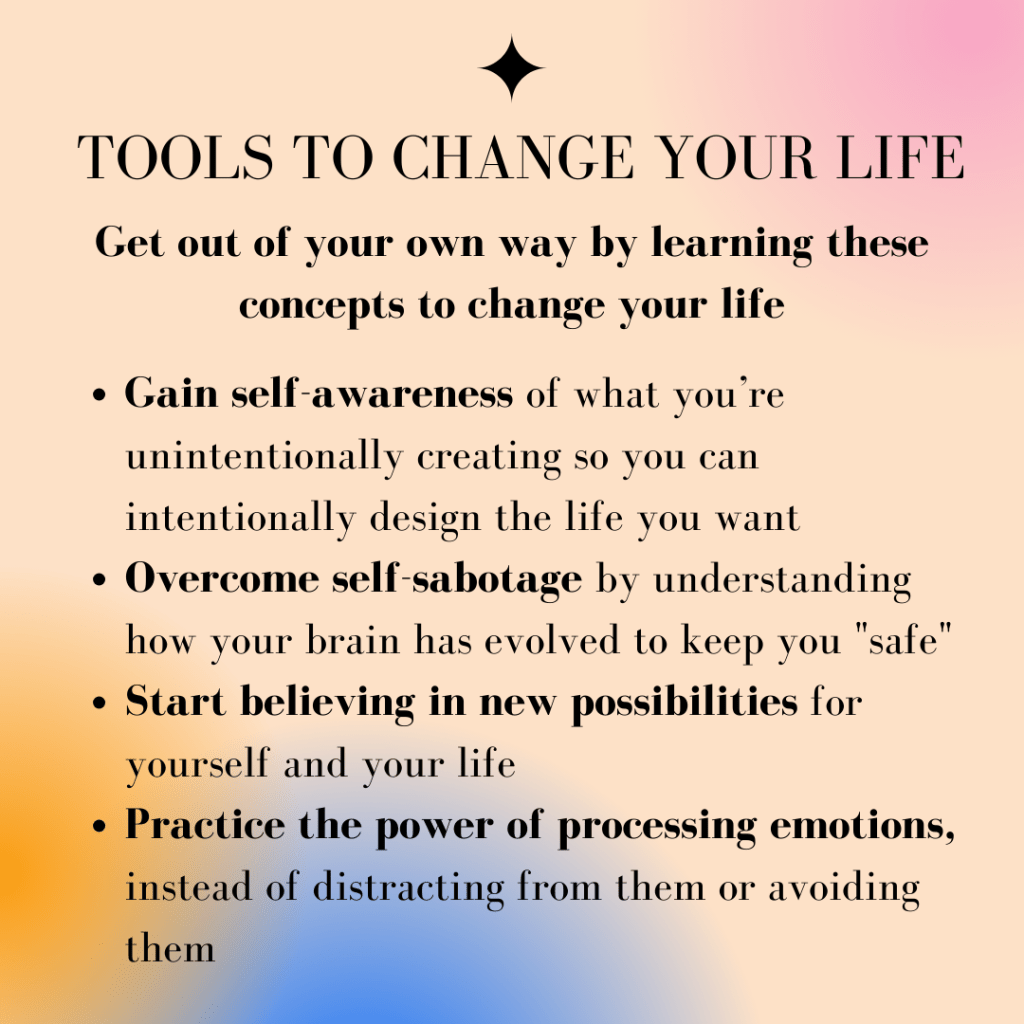
I talk more about how to be intentional with your thoughts in my program Tools to Change Your Life. Check it out here!

Subscribe if you want to receive this content directly in your inbox.

Work with me: Want to see how self-care is transformative and can help you create the results you want in your life? I can show you how. I offer first-time seekers a complimentary 45-minute exploratory session. Sign up here.

What’s on your mind? It can be powerful to learn from each other and our common struggles when it comes to our practice of self-care–or just being a human being. If you have something you’re struggling with and would like some perspective, share it here. Your issue may be chosen and addressed in the next post–it’ll be totally anonymous.

How to feel worthy

Pay attention to YOU.

To feel worthy, you must first make your own instincts worthy of your attention and your effort.

pg. 223 (From The 5 Second Rule by Mel Robbins)

Many of us struggle or have struggled to feel worthy. We know that it’s important to feel worthy. We know that we should feel worthy. But how do we actually start to feel worthy? Where does worthiness come from? 

In my experience, feeling worthy is a process. It doesn’t happen overnight, though when it does happen, it seems to have happened overnight! But it’s really due to all the work we’ve done with ourselves over time.

The first step to feeling worthy is to become aware of the ways in which we don’t feel worthy. This can show up in different forms and in different areas of our lives. Maybe we feel worthy in some aspects of our lives, so getting accolades at work feels natural. Or being in a healthy partnership comes easy. Or being financially stable is just a “given.” 

But in the areas in which we don’t feel worthy, those are the areas where we struggle. 

  • We don’t feel we deserve great friendships, so we shy away from connection and wonder why we feel lonely.
  • We don’t feel worthy of the praise from our boss, so we don’t believe her kind words.
  • We don’t feel deserving of the gifts from our loved ones on our birthday, so we feel guilty receiving them.
  • We think the new apartment we moved into is “too good” for us and feel undeserving to live there.
  • We wait for the other shoe to drop when a new relationship starts, like “Wait until they really get to know me…” or we end up sabotaging it ourselves. 

Again, it can come up in various forms. 

To feel worthy, one thing we must do for ourselves is to pay attention to ourselves. For me, I was always disregarding myself, ignoring myself, abandoning myself.

I did this in order to please others, to have what I THOUGHT I wanted, even if it meant dishonoring my needs and what I REALLY wanted. I wasn’t paying attention to myself, my instincts, and what was true for me. I tried to convince myself to want what didn’t really align with me, I contorted myself to fit what someone else wanted. I lied to myself and lied to others – unintentionally – because I thought it was the “right” thing to do in order to seek approval. 

By paying attention to ourselves, we learn what is true for us and how truth FEELS for us. We then know when we’re lying to ourselves. When we lie to ourselves, that is a form of abandoning ourselves. When we pay attention to ourselves, we show ourselves that we are worthy of attention and effort. Especially from ourselves.

When we start paying attention to ourselves, our thoughts, feelings, and behaviors change. They become more aligned with our truth. We start to see that we have always been worthy. And what we are engaging in is the process to UNLEARN our feelings and beliefs of UNworthiness. 

I learned about some of my unhealthy beliefs about worthiness through therapy and life coaching. And I’ve been doing the work to UNLEARN all the ways I thought I wasn’t worthy before. Coming from a place of worthiness changes everything.

So I’ve created an introductory coaching series called “Tools to Change Your Life” to support others on their own path to UNlearning all the ways they believed they were unworthy before to seeing that they have ALWAYS been worthy.

You can consider this program for yourself or for someone in your life who could benefit from a program like this!


Subscribe if you want to receive this content directly in your inbox.

Work with me: Want to see how self-care is transformative and can help you create the results you want in your life? I can show you how. I offer first-time seekers a complimentary 45-minute exploratory session. Sign up here.

What’s on your mind? It can be powerful to learn from each other and our common struggles when it comes to our practice of self-care–or just being a human being. If you have something you’re struggling with and would like some perspective, share it here. Your issue may be chosen and addressed in the next post–it’ll be totally anonymous.