Building trust with yourself

It’s up to you.

First, I’d like to celebrate this anonymous note from a fellow self-care seeker, received after last week’s post titled “How’s your body doing?”:

“Just a comment to say how timely this email was for me today. I work a full time job and part time in [another job] and had today off. I slept until almost 11:00. I have felt guilty about it since I got up hearing my husbands often comment “you slept half the day away!” rattling around in my head. I pushed back and remembered how poorly I’ve slept the last week and reminded myself that my body wouldn’t have slept that long if it wasn’t tired. I had an event scheduled for this weekend that got canceled. Someone else called and wanted me for another event, and I lied and said I had made plans already. I felt guilty for the money I’m giving up but also empowered by being honest that I just can’t do another 6-7 day work week. I’m 61 years old and just tired. So thank you for the affirmation that told me that my choices were indeed OKAY. I AM ENTITLED TO REST.”

Thank you so much for sharing this experience – I loved reading your empowering and inspiring words! Keep telling yourself the truth, listening to your body, and honoring what it needs and wants! And celebrate when you do.

Now, on to building trust with ourselves …

There are different ways we learn how to trust (or not trust) ourselves. One of these ways is by doing (or not doing) what we say we’ll do – especially when it comes to ourselves. 

Most of the time, we do what we say we’ll do for other people. This is because we know the consequences of not following through: the other person will feel let down and disappointed and possibly change how they think about us, and then we’ll feel guilty for having disappointed them and think we need to make up for it somehow.

But what happens when we say we’ll do something for ourselves and then we don’t do it? Let’s say we put an hour on our calendar to do one of the following things: go to the gym, do a yoga class, take a walk, read for leisure, or cook a healthy meal. 

But we end up blowing ourselves off during that hour by using that time to keep working, scroll on social media, go out for drinks instead, or do something else besides what we had planned for ourselves. 

When we’re the ones not keeping our commitment to ourselves, we feel a double whammy – we’re the ones who are let down and disappointed AND we’re the ones feeling guilty about letting ourselves down. That feels doubly bad. And yet we might not even feel the need to make up for it.

Knowing this feeling, the next time we go to make a commitment to ourselves, we might avoid disappointing ourselves and feeling guilty about it ahead of time, so we might think, “Why bother? I’m not gonna do it anyway.” 

And then nothing moves forward with keeping commitments and building trust with ourselves. 

That’s how a defeating mindset begins when we think about making commitments to ourselves. We diminish our trust with ourselves when we don’t follow through on what we say we’re going to do for ourselves.

To build trust with ourselves, we can take small steps. “Today I’m going to walk around the block at 3pm.” 

And then at 3pm, we do what we say. We get up and walk around the block. 

When we do this, there’s a sense of empowerment, a sense of accomplishing something and fulfilling a promise to ourselves – no matter how small. “It feels good to do what I said I would!” Celebrate that and remember the feeling. 

This is how we start to strengthen the muscle of trusting ourselves more, knowing that we can have our own back. We can continue to make another small commitment to keep each day – it could be the same one! – until it’s just automatic for us to keep our word to ourselves. Until it feels uncomfortable when we don’t keep our word to ourselves. 

When we get even better at keeping commitments to ourselves, we build even more trust with ourselves. We start to know what it truly feels like to have our own back – no matter what. 

Your turn: What is one small commitment you want to make to yourself today that you’ll do tomorrow? When tomorrow comes, are you willing to build trust with yourself and do the thing? If you still find yourself not doing the thing, are you open to asking yourself if this is something you truly want to do for yourself or is something else telling you “you should” do it?

Subscribe if you want to receive this content directly in your inbox.

Work with me: Want to see how self-care is transformative and can help you create the results you want in your life? I can show you how. I offer first-time seekers a complimentary 60-minute exploratory session. Sign up here.

What’s on your mind? It can be powerful to learn from each other and our common struggles when it comes to our practice of self-care–or just being a human being. If you have something you’re struggling with and would like some perspective, share it here. Your issue may be chosen and addressed in the next post–it’ll be totally anonymous.

How’s your body doing?

Connect.

How many of us know how to connect with and listen to our body’s signals and messages to us? Most of us didn’t really learn how to do this anywhere. In fact, we were likely taught the opposite—how to ignore and disregard our bodies: to keep going when we’re tired, to push through the pain to get it done, to always be productive and go after the next thing. 

After undergoing emergency open-heart surgery that saved my life and while going through the recovery process, I learned better how to listen to and honor my body. In actuality, it was because I didn’t know how to do that sooner that I got to the place of needing emergency open-heart surgery. I wasn’t understanding my body’s signals that led to my body’s illness. 

In the past, when I wasn’t feeling well, I didn’t allow myself to rest without feeling guilty, like I shouldn’t be taking the time off. And guess what happened when I felt guilty for resting when my body needed it? I created more stress because I was feeling guilty about resting and thinking I should be doing something else!

Resting when our bodies need it can be a hostile cycle if we’re not aware of what’s going on in our minds during the time. Part of us knows that we need rest and another part of us thinks about all the other things we “should” be doing but aren’t. So while we’re resting, there’s cognitive dissonance–we’re not at peace with our decision to rest. 

One way to be at peace with resting and caring for ourselves is to be compassionate with ourselves, to accept that we need to rest, and to consciously choose to rest: “I am choosing to rest and care for myself. There is nothing else I need to do right now. This is important and resting will allow me to do the things I want to do later.” This may help to decrease cognitive dissonance.  

This relates to more than just resting. It relates to what we choose to eat, drink, and do with our bodies, as well. 

So, instead of ignoring my body’s messages, I learned to slow down and check-in with my body, to familiarize myself with its signals. I learned to ask the questions: “At what cost?” and “What can I do to take care of myself in this moment?” 

And when the answer came, I gave myself permission to listen to and honor it. It could mean deciding to sleep in instead of going to the gym, or remembering to breathe deeply, or drinking some water, or choosing to eat (or not eat) something, or canceling evening plans after an unexpectedly tiring day at work. 

A realization that I came to while learning to listen to and honor my body more, was that by not listening to my body, I was disrespecting and disregarding myself. 

Self-care became a way to show myself respect and love, to regard myself with attention. How often do we expect love, respect, and attention from others when we might not even be giving these things to ourselves?

In the past, I thought that by pushing past my body’s needs, I was “being responsible” and getting things done that I thought I needed to do. But by not taking care of my body, that was actually being irresponsible. I see that now, but I didn’t see it in the past–likely because many of our societal messages told me the opposite. 

When we begin connecting to our body even more, we learn how to regard our body with attention, to listen to what our body needs. Then we can honor it by supporting it in a healthy, caring, respectful way.

Your turn: What can you do today to start connecting to your body more? Are you open to asking yourself the questions: “At what cost?” and “What can I do to take care of myself in this moment?” What might happen if you decided to give care and attention to yourself, to slow down and check-in with your body first?

Subscribe if you want to receive this content directly in your inbox.

Work with me: Want to see how self-care is transformative and can help you create the results you want in your life? I can show you how. I offer first-time seekers a complimentary 60-minute exploratory session. Sign up here.

What’s on your mind? It can be powerful to learn from each other and our common struggles when it comes to our practice of self-care–or just being a human being. If you have something you’re struggling with and would like some perspective, share it here. Your issue may be chosen and addressed in the next post–it’ll be totally anonymous.

Being indecisive is “easier”

Just decide.

Have you ever needed to make a decision about something but you allowed yourself to be indecisive about it instead? 

This could look like overanalyzing the pros and cons, asking other people for their opinion more than once, doing “more” research, switching back and forth between one decision and another, and procrastinating on taking action.

It can be worrying about whether it’s the “right” or “wrong” choice.

So we let ourselves stay in the mode of “I don’t know” or “I’m not sure.”

Our brains want to keep us safe and staying in “I don’t know” or “I’m not sure” is one way it does this. 

When we keep telling ourselves “I don’t know” or “I need more information” or “How will I know this is the right choice?” we block ourselves from deciding, because deciding can be scary. 

Deciding means we will have to take action. 

Deciding means stepping into the unknown. 

Deciding means we could potentially fail. 

Deciding means possibly having a difficult conversation.

Deciding means we may have to take on more responsibility.

Deciding means we may be successful beyond our wildest dreams.

All of that can feel scary. And all of that will also help us grow if we’re willing to see our decision as an opportunity for growth. If we’re willing to learn what there is to learn from this choice, even if it ends up being the “wrong” choice. 

Personally, I don’t believe in “wrong” choices—they’re just experiences to learn from. And we can always change our minds.

Also, a lot of our energy goes into being undecided. Our brains keep going over and over the options, the pros and cons, the potential outcomes, the worst-case scenarios, etc.-–sometimes for hours or days or weeks. For the same decision. 

That’s a lot of brain space that could be used for more productive means. Like creating the life we want. But instead, we think and think without creating forward momentum from all that thinking.

One thing that is powerful when making decisions is to like our reasons. Are we making this decision because it’s the “easy” choice, where we don’t have to stretch or expand ourselves? Are we making this choice from a place of self-love or self-sabotage? 

When we like our reasons for our decision, there is liberation in deciding.

We won’t know what will happen until we decide and take the next steps. 

Your turn: Do you recognize when your brain is keeping you safe by being stuck in “I don’t know” or “I’m not sure”? Are you willing to just decide instead, to like your reasons for your decision, and to have your own back no matter what? 

Will this choice move you toward an inspiring future or will it keep you stuck in the past? What’s the worst-case scenario if you make the decision you want to make? How will you be able to survive it? 

Subscribe if you want to receive this content directly in your inbox.

Work with me: Want to see how self-care is transformative and can help you create the results you want in your life? I can show you how. I offer first-time seekers a complimentary 60-minute exploratory session. Sign up here.

What’s on your mind? It can be powerful to learn from each other and our common struggles when it comes to our practice of self-care–or just being a human being. If you have something you’re struggling with and would like some perspective, share it here. Your issue may be chosen and addressed in the next post–it’ll be totally anonymous.

When you show up for life

You choose.

Many of us head into our days somewhat haphazardly. We might not have a morning routine established yet where we get to step into our day, but our day seems to “come at” us instead.

One quick practice that can impact our day is setting an intention for how we want to show up that day.

The way I talk about showing up means not just being in the room or being somewhere, but how we interact with ourselves and how we interact with others. On purpose. 

We can decide in the morning what our intention is for showing up today. We can decide how we want to show up for ourselves and we can decide how we want to show up for others.  

An intention for showing up for ourselves can sound like this:

“I want to show up for myself today by acknowledging what’s good in my life.”

“I want to show up for myself today by honoring my commitments.”

“I want to show up for myself today by telling the truth to myself.”

An intention for showing up for others can sound like this:

“I want to show up for others today by hearing what they have to say.”

“I want to show up for others today by being compassionate towards them.”

“I want to show up for others today by being patient with them.”

We can choose on purpose. And it doesn’t mean we do it 100% that day. But we can start. And we can keep practicing. 

Your turn: What intention do you want to set for showing up for yourself today? For showing up for others? What intentions might you turn into habits? What awareness do you want to bring to this practice? 

Subscribe if you want to receive this content directly in your inbox.

Work with me: Want to see how self-care is transformative and can help you create the results you want in your life? I can show you how. I offer first-time seekers a complimentary 60-minute exploratory session. Sign up here.

What’s on your mind? It can be powerful to learn from each other and our common struggles when it comes to our practice of self-care–or just being a human being. If you have something you’re struggling with and would like some perspective, share it here. Your issue may be chosen and addressed in the next post–it’ll be totally anonymous.

Ruminate much?

It’s a thought error.

I learned the term “thought error” from my teacher at The Life Coach School. Thought errors are also known as cognitive distortions, which are automatic, often unrealistic ways of thinking that can rapidly affect our mood and create or keep us stuck in cycles of anxiety, sadness, or other difficult emotions. Thought errors and cognitive distortions include all-or-nothing thinking, catastrophizing, jumping to conclusions, and personalizing, among others. 

A thought loop is when we keep repeating the thought error over and over again. It’s also known as ruminating (which is related to a cow chewing its cud, chewing on something over and over again). And we know our thoughts create our feelings, so whatever thought is looping, the feeling will likely persist and get stronger as well. 

Usually it’s the feeling of fear—or some form of it (worry, anxiety)— that drives us to loop our thoughts. And it makes sense because our brains have evolved to keep us alive and safe, so it’s usually looking for threats in the world. Most of the time, the threats are created in our minds.

I was very familiar with thought errors and thought loops. I ruminated and made up stories about facts. It’s easy to make up stories about facts:

We’re used to telling ourselves stories about facts. We make facts mean something about us, usually that we’re not good enough or we’ll never have what we want. 

A helpful way to remind us that we are thinking thoughts and that they are OPTIONAL is to add these phrases to our thoughts:

“I’m just thinking the thought _____.”

“I notice I keep thinking the thought _____.”

“I’m telling myself the story that _____.”

“Right now I’m thinking the thought ______, and that’s okay.”

Then we can find some space between our thoughts and what we think is fact. Sometimes this can create some peace or ease for us. We can discover that we are NOT our thoughts. We can start to become aware of our thoughts and then start CHOOSING THEM on purpose to serve us.

Your turn: The next time you find yourself ruminating or looping thoughts, remind yourself that you’re thinking thoughts and possibly making up stories about facts. What are the facts? What is the story you’re telling yourself about the facts? When you remind yourself of the story vs. the facts, how do you feel differently?

Subscribe if you want to receive this content directly in your inbox.

Work with me: Want to see how self-care is transformative and can help you create the results you want in your life? I can show you how. I offer first-time seekers a complimentary 60-minute exploratory session. Sign up here.

What’s on your mind? It can be powerful to learn from each other and our common struggles when it comes to our practice of self-care–or just being a human being. If you have something you’re struggling with and would like some perspective, share it here. Your issue may be chosen and addressed in the next post–it’ll be totally anonymous.

When you judge yourself

How’s that working out for you?

How does compassion for ourselves motivate us differently than judgment of ourselves?

Most of us are used to judging or punishing ourselves into action. This might sound like: 

“I’m so fat, I need to workout extra hard today.” 

“I’m such a loser, I have to figure out how to make more money.” 

“I’m so inadequate, I need to find a partner.” 

“I’m a mess, I have to get this right.”

Whatever it is, we think mean things about ourselves in order to “motivate” us to do what we think we need to do in order to feel better about ourselves. We think we need to beat ourselves up in order to take helpful actions. “If I stop beating myself up, if I accept myself the way I am, I’ll get complacent and lazy, and never change.” 

We might be in a rush to get “over there” because we think that’s when we’ll feel better about ourselves. Beating ourselves up may have gotten us results in the past, but at what cost to our relationship with ourselves?

When we have a self-judging narrative, everything we do can feel punishing:

    • Instead of seeing a healthy plate of food that will nourish our body, we see a restrictive, limited diet
    • Instead of doing a workout and celebrating what our body can do, we see it as a way to burn calories-–sometimes even as a penalty for “not eating right”
    • Instead of staying happy in a new relationship, we find ways to prove that we’re not worthy of happiness
    • Instead of becoming aware of how we talk to ourselves, we beat ourselves up for beating ourselves up!

Kindness, love, and respect for ourselves doesn’t start when we hit a certain goal of ours. 

In fact, when we do hit that goal without doing the work of self-compassion and acceptance, the reward will likely be temporary and we might still not like ourselves the way we thought we would when we finally get “over there” by hitting that goal. It’s because achieving goals doesn’t create our feelings. Our thoughts create our feelings. 

Kindness, love, and respect for ourselves can start right now, exactly as we are. 

Decide that that’s possible. 

When we have compassion and acceptance for ourselves exactly as we are at this time, we can start making the changes we want to see in our lives from a place of care, love, and patience. 

It’s about our relationship with ourselves. So that in the long-run, we are where we want to be with ourselves and in our lives, loving and accepting ourselves along the way. No matter what.

Your turn: Are you open to feeling accepting of yourself as you are right now? If not, what’s getting in the way? What are some of the self-judging thoughts you’re aware of? What are some self-compassionate thoughts you can have about yourself instead? What would happen today if you found some compassion for yourself in a situation where you usually beat yourself up?

Feeling challenged by finding more self-compassionate thoughts? Book an exploratory session here to build your self-compassion practice.

Subscribe if you want to receive this content directly in your inbox.

Work with me: Want to see how self-care is transformative and can help you create the results you want in your life? I can show you how. I offer first-time seekers a complimentary 60-minute exploratory session. Sign up here.

What’s on your mind? It can be powerful to learn from each other and our common struggles when it comes to our practice of self-care–or just being a human being. If you have something you’re struggling with and would like some perspective, share it here. Your issue may be chosen and addressed in the next post–it’ll be totally anonymous.

Your limiting beliefs

Believe on purpose.

We can create new outcomes in our lives with the thoughts that we think. It may seem more complex than that, but really, all new things come from ideas, which are thoughts.

And we know from our coaching model that our thoughts are what create our feelings. Our feelings are powerful drivers of our actions. And our actions create the results we get in our lives. 

When we want to create something in our lives, sometimes we need to have new beliefs about what’s possible. Beliefs are just thoughts that we’ve thought over and over again and now we believe they are true. 

Some beliefs are very useful to us. And some beliefs create limits within us and prevent us from doing things.

Some limiting beliefs might be:

  • I’m not good enough.
  • I just don’t have enough confidence.
  • I’m not talented enough.
  • I don’t have the discipline to do that.
  • People don’t understand me.
  • All the good ones are taken.
  • I won’t ever be successful.
  • I hate my body.

Once we’re aware of limiting beliefs we hold, we might feel the need to change them right away to their exact opposites—things that we DO want to believe. 

But if we take too big of a leap, we’ll have a thought that we don’t yet believe. And that thought won’t help us because we don’t believe it yet, no matter how many times we may repeat it during the day. 

So how do we get to the new belief we want to have that seems so far from our current belief? We practice thoughts that bridge us or ladder us to the next level of thinking.

As an example, let’s take the thought “I hate my body.” 

The goal thought might be “I love my body.” But it’s hard to jump from hate to love right away. 

Here are some potential ladder thoughts from “I hate my body” to “I love my body”:

  • I hate my body.
  • I have a body.
  • There are other people with bodies like mine.
  • Other people with bodies like mine seem to like their bodies.
  • It’s possible that I could like my body.
  • My body has the potential to change and be healthier.
  • I am living my life because of my body.
  • My body allows me to do things I enjoy.
  • I am learning to enjoy being in my body.
  • I am learning to love my body.
  • I love my body.

We may need to practice each ladder thought for a couple days, a week, two weeks, etc. before moving on to the next one. Until we truly believe the thought we are practicing, it’s important to stay with it before moving on to the next one.

Our thoughts are powerful. We can learn to create beliefs that empower us instead of disempower us. 

Your turn: What are some of the limiting thoughts/beliefs you hold? What are some goal thoughts/beliefs that you’d like to have instead? Explore and practice some ladder or bridge thoughts that can help you get to your goal thoughts. 

Need help exploring some ladder or bridge thoughts? Sign up for an exploratory session here.

Subscribe if you want to receive this content directly in your inbox.

Work with me: Want to see how self-care is transformative and can help create a more meaningful life in which you start committing to yourself and show up the way you want? I can show you how. I offer first-time seekers a complimentary 60-minute exploratory session. Sign up here.

What’s on your mind? It can be powerful to learn from each other and our common struggles when it comes to our practice of self-care–or just being a human being. If you have something you’re struggling with and would like some perspective, share it here. Your issue may be chosen and addressed in the next post–it’ll be totally anonymous.

What if it’s not a problem?

Let it be.

Because our human brains have evolved to help us survive, we are still very aware of things that pose potential threats. But sometimes we like to create problems when there really aren’t any. Something only becomes a problem once we THINK it is one. 

And when we make something a problem, we start thinking of all the ways to “fix” it—which is really only worrying about it and making it even more of a problem in our minds. 

For example, if we’re having trouble falling asleep, is that a problem? Not until we think it is. We might feel frustrated that we can’t fall asleep. We might tell ourselves why it’s so important that we get the right amount of sleep. We create a “bad” story about our sleep, which creates anxiety ahead of time. This does not help us fall asleep faster. 

Instead, we can also think, “I’ll fall asleep when I do and I’ll get the amount of sleep my body needs.” Less of a problem now.

We can practice asking ourselves, “What if it’s not a problem? What if there is no problem and nothing to fix?”

What if:

  • – Feeling sad about this outcome isn’t a problem?
  • – Waking up in the middle of the night isn’t a problem?
  • – What that person said isn’t a problem?
  • – The number on the scale isn’t a problem?
  • – Missing him isn’t a problem?
  • – Her anxiety isn’t a problem?

When something isn’t a problem, we often feel more acceptance around it. And paradoxically, when we accept something, we are more open and willing to take aligned actions for ourselves. 

So if the number on the scale isn’t a problem, maybe we’d be more willing to make healthy choices. If waking up in the middle of the night isn’t a problem, maybe we’d be able to fall back asleep again. If missing him isn’t a problem, we can allow the feeling and still live our lives the way we want to.

So, “What if it’s not a problem? What if there is no problem and nothing to fix?”

Your turn: What have you been making a problem? What if it’s not a problem? What would you think about instead? What would you do instead?

Subscribe if you want to receive this content directly in your inbox.

Work with me: Want to see how self-care is transformative and can help create a more meaningful life in which you start committing to yourself and show up the way you want? I can show you how. I offer first-time seekers a complimentary 60-minute exploratory session. Sign up here.

What’s on your mind? It can be powerful to learn from each other and our common struggles when it comes to our practice of self-care–or just being a human being. If you have something you’re struggling with and would like some perspective, share it here. Your issue may be chosen and addressed in the next post–it’ll be totally anonymous.

What? I don’t have needs

Yes, you do. And that’s OK.

When I first learned that having needs is a part of the human experience and that it was “OK” to have needs, I felt embarrassed for myself. I thought, “What? I shouldn’t have needs.” 

I was conditioned to think that having needs was a weakness, that being “needy” was undesirable. So I was resistant to the idea of actually having needs. 

But as I learned more about feelings and needs via the Non-Violent Communication (“NVC”) philosophy by Marshall Rosenberg, I began to understand myself better. 

I learned how needs are an important part of our lives and for living fully and authentically. I started to accept that I DO have needs. I became more familiar with my needs and what they communicate to me and my lived experience. I became more connected to myself. 

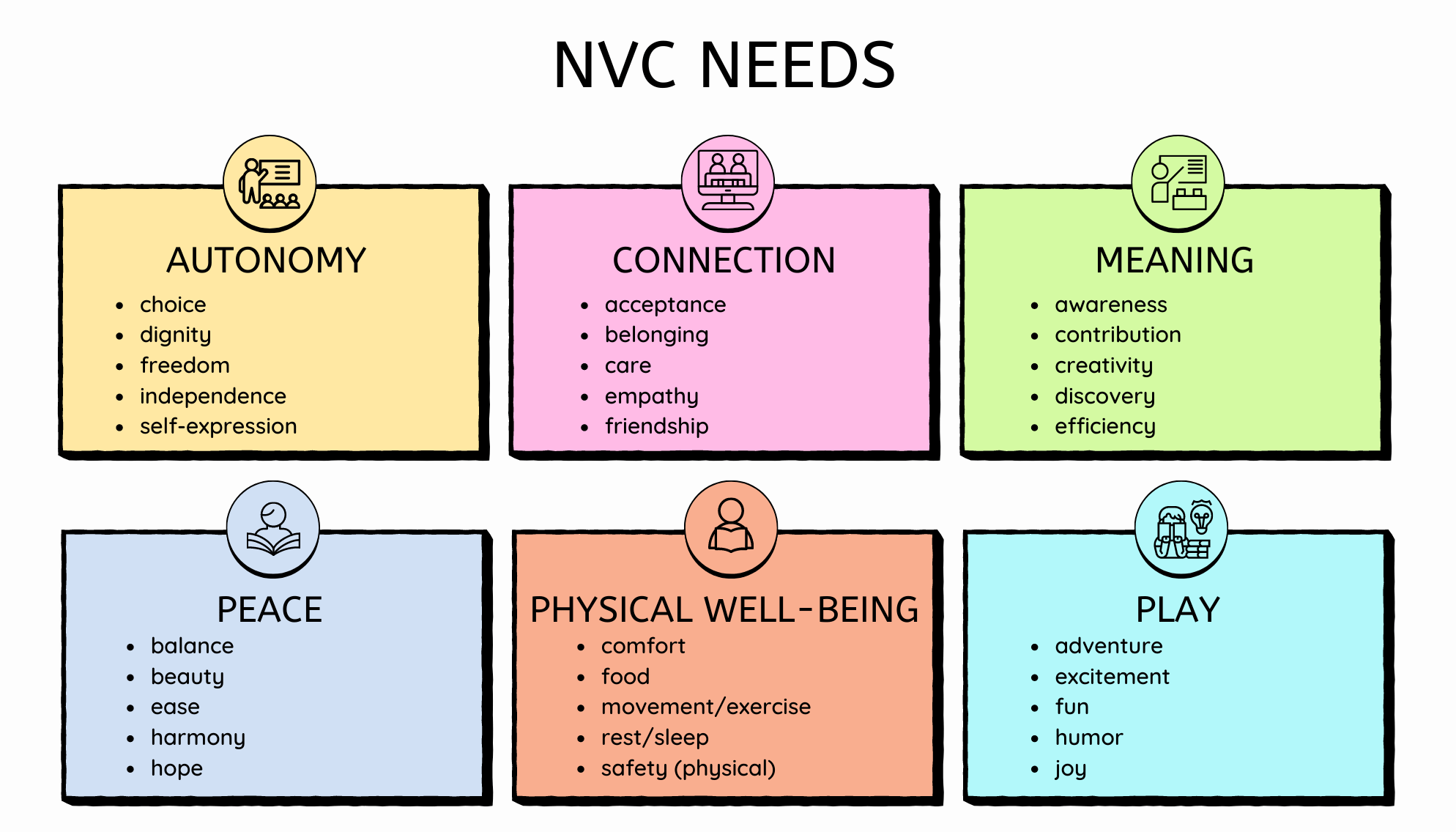
In NVC, having needs is universal to all humans. It’s different than the dictionary definition for “need.” For example, here are a few universal human needs (here is a fuller list):

We know from the Model that our thoughts create our feelings. In NVC, we recognize that our feelings are also based on whether or not our needs are being met. When we have “met” or “unmet” needs, we’ll have a thought about what’s going on when our needs are met or unmet and then feel a feeling associated with that thought. 

NVC teaches us how to acknowledge our needs and make requests from other people to help meet our needs. However, we are ultimately responsible for meeting our own needs by connecting with and taking care of ourselves. 

Your turn: What needs of yours do you want to acknowledge and even embrace? How might doing this provide more connection to yourself and your lived experience? What do you want to learn more about needs and how to express them in healthy ways?

Subscribe if you want to receive this content directly in your inbox.

Work with me: Want to see how self-care is transformative and can help create a more meaningful life in which you start committing to yourself and show up the way you want? I can show you how. I offer first-time seekers a complimentary 60-minute exploratory session. Sign up here.

What’s on your mind? It can be powerful to learn from each other and our common struggles when it comes to our practice of self-care–or just being a human being. If you have something you’re struggling with and would like some perspective, share it here. Your issue may be chosen and addressed in the next post–it’ll be totally anonymous.

When it’s taking too long

We get to do the work.

When we’ve been doing the work of growing and expanding ourselves by learning concepts and tools to help us evolve into who we want to become, sometimes we may think, “I should know this already. I should be better at this. Why am I still reacting this way? Why is this still hard for me?”

Why, my friends? Because we are human beings with human brains.  

Just because we know the work, the tools involved, and the ways of thinking that can benefit us, doesn’t mean we no longer have human emotions and human experiences. That we no longer have to do the work. 

We learn the tools and beneficial ways of thinking in order to help us navigate our human experience on purpose, consciously and deliberately, with compassion and grace for ourselves and others. 

There isn’t a point where we get to stop doing the work—unless we choose to be stagnant and stay exactly where we are. It’s possible to do that, but also as human beings, it’s unlikely that we’ll want to choose that for ourselves.

We will always get to do the work. And that’s not a “bad” thing. It means that we’re continuing to expand ourselves and grow beyond where we currently are. That we want to be even more of who we are becoming.  

Our primitive brains evolved to want to be efficient (to do “easy” things), to avoid pain, and to seek pleasure to help us survive. 

When we’re wanting to live a fulfilled life where we’re not just surviving but thriving, we can’t always choose the easy things, we will likely be uncomfortable facing new situations and experiences, and we will delay immediate pleasure/gratification in order to attain our long-term well-being. 

So we do the work in order to overcome our primitive brains and utilize our sophisticated brains (our prefrontal cortex) to their fullest potential. 

Some thoughts for helping us continue doing the work:

  • I’m getting better at processing my emotions.
  • This is still hard for me, and that’s okay.
  • I’m learning something from this and that’s why I don’t already know better.
  • I’m reacting this way and catching myself instead of being unaware.
  • My awareness is helping me through this.
  • I can see that I’m learning and growing through this challenging experience.

The work is always here. No matter how much we know, we don’t get to escape the work. And it’s worth it to see who we become.

Your turn: Are you willing to keep doing the work to become the best version of you possible? Instead of thinking “This is taking too long,” are you willing to process and be with your feelings for as long as it takes? Are you open to remembering that you always have a choice to do the work or to not do it, and to confront the consequences depending on what you choose?

Subscribe if you want to receive this content directly in your inbox.

Work with me: Want to see how self-care is transformative and can help create a more meaningful life in which you start committing to yourself and show up the way you want? I can show you how. I offer first-time seekers a complimentary 60-minute exploratory session. Sign up here.

What’s on your mind? It can be powerful to learn from each other and our common struggles when it comes to our practice of self-care–or just being a human being. If you have something you’re struggling with and would like some perspective, share it here. Your issue may be chosen and addressed in the next post–it’ll be totally anonymous.